News signal
Kawasaki Heavy Industries announced its Physical AI Center San Jose on 22 May 2026 and named NVIDIA, Analog Devices, Microsoft and Fujitsu as collaborators. Its release says the center will initially work on healthcare, elder care and mobility, while linking to development bases in Japan and Europe. Kawasaki describes several existing platforms as possible ingredients for future solutions. This is a statement of direction from the company, not evidence that a common product, hospital deployment or service level is ready. The news matters to a Japanese robotics buyer because the proposed work spans physical machines, sensors, AI, cloud software and business systems. Each boundary can fail differently, and a list of collaborators cannot itself tell an operator who will restore a stopped workflow.
COCON operational interpretation
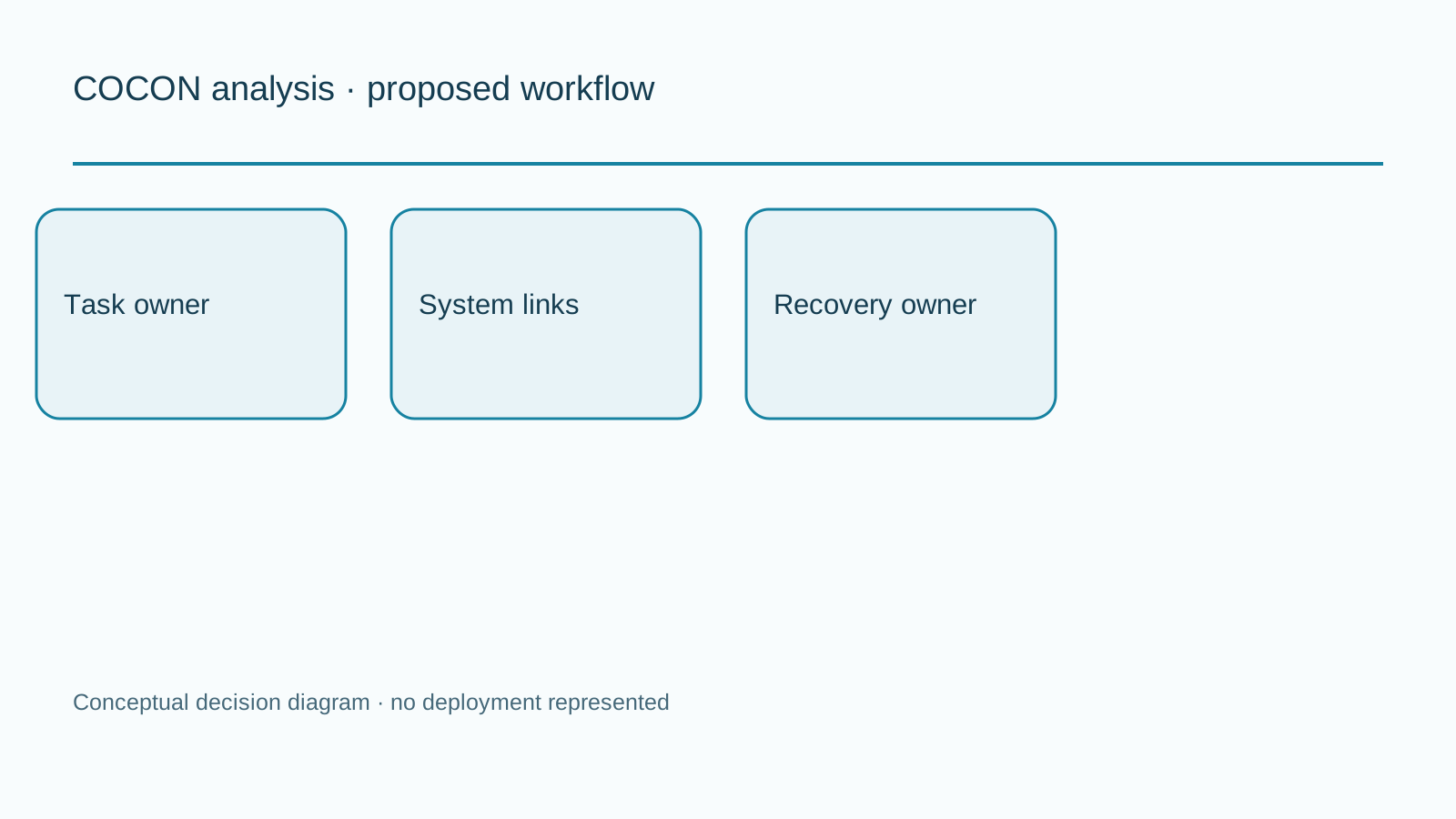
COCON analysis: the useful question is where operational responsibility sits when several specialists contribute to one task. A buyer should start with a service outcome, then identify the person authorized to pause, change and restart that service. The center may help suppliers coordinate development, but Kawasaki has not published an architecture, integration contract or measured availability for the combined stack. Treat those missing details as purchasing questions, not as criticism of an unannounced product. For a Japanese organization considering physical AI, the immediate lesson is to write down ownership of data, safety decisions and incident response before comparing models. The decision is about a bounded process and its recovery path, not the novelty of a single demonstration.
Affected workflow
Take a hypothetical internal transport request in a controlled facility. A person creates a request; a business application checks its destination and priority; dispatch software assigns a device; the device crosses a route; a receiving person confirms delivery. The proposed workflow ends only when the confirmation or a documented exception returns to the requesting system. This is a COCON example, not a report of a Kawasaki installation. Name the process owner and the staff who can clear an obstruction, handle a lost network connection, or move the item manually. Record which step contains sensitive information and which system is permitted to retain it. A robot's movement is only one step in the full service.
Maturity and evidence
The primary release establishes a new development and co-creation hub. It says Kawasaki intends to use its platforms and work with named technology companies; it does not report a validated common solution, multi-site operating record or published acceptance test. The platforms mentioned in the announcement address different domains. Their presence in one release should not be read as interchangeability. A procurement team can call the center a development initiative and can call a local test a pilot once a real site and operator approve it. It should not label the planned combined service production-ready merely because each contributor has technology in market. Readiness belongs to the complete workflow under defined conditions, including failures and human takeover.
System design
A proposed architecture begins with an approved task definition and a map of the operating area. A task record needs an identifier, origin, destination, payload class, deadline and state. The integration layer should prevent duplicate dispatch and should return a clear failure state to the business application. Sensors and robot controls need their own local safety behavior if cloud communication stops; cloud logic must never be treated as the only protective layer. An operator interface should show task state and a safe way to intervene. Keep raw media, location data and personal information within a documented retention boundary. These are COCON design questions for a future pilot; the release does not specify that Kawasaki's center implements this particular design.
Accountability across suppliers
Multi-supplier work needs a single incident commander at the customer site. A responsibility table can distinguish the facility owner, robot supplier, sensing supplier, AI provider, cloud provider and application owner. Assign each one a test obligation, log format, escalation contact and change-control approval. If a delivery fails, the operator should not have to discover which company's dashboard contains the answer. The contract should state who owns the event timeline and who has authority to return equipment to service after a stop. A data interface alone does not settle liability, cybersecurity or staff training. COCON would ask for a joint failure drill and one signed recovery procedure before expanding the route.
One bounded pilot
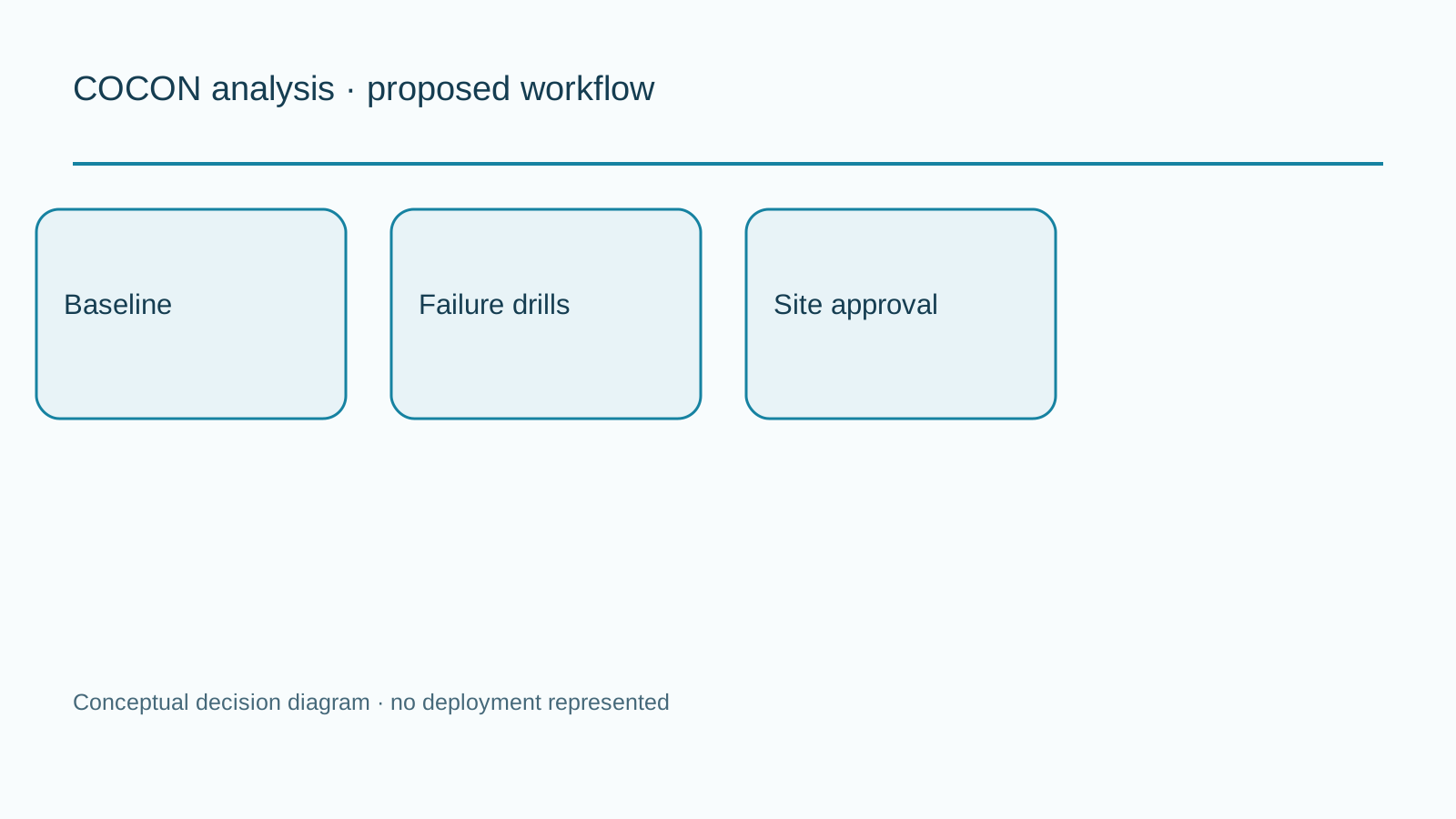
COCON pilot proposal: choose one low-consequence transport task inside one approved area, with a clearly defined start and handoff point. Do not include clinical decisions, patient handling or autonomous movement through uncontrolled public space. The site owner selects the route, maps crossings, checks floor and radio conditions, and agrees on manual fallback. Operate in observation mode first, then supervised trial periods with a trained attendant. The pilot can run for a locally agreed period only after a documented risk assessment; the release offers no universal safe duration. Keep a change log so that updates to maps, models and dispatch rules can be tied to outcomes. Stop the trial when a safety boundary is breached, an unexplained duplicate task occurs, or recovery cannot be completed as written.
Baseline and acceptance criteria
Before installing equipment, count requests, completed handoffs, manual interventions, delays and unplanned stops for the same workflow under the existing process. Record the mix of routes and the reasons for exceptions, not just an average time. COCON proposes acceptance gates: every pilot task has one traceable state history; a lost connection results in a safe local state and an explicit operator alert; duplicate requests are identified without a second physical movement; staff can use the manual fallback; and the receiving step can reconcile completion or failure. The site should set numerical thresholds only after seeing its own baseline and risk assessment. A demonstration video, isolated navigation success or vendor laboratory figure cannot substitute for this site-specific comparison.
Risks and limitations
The principal limitations are uncertainty about the eventual interface, the range of tasks, and support arrangements. The Kawasaki release describes collaboration themes but does not publish a common SLA, cybersecurity boundary or clinical validation. In a real facility, blocked corridors, elevators, changing layouts, radio dead zones and priority conflicts can interrupt an otherwise convincing demonstration. Human workload can also rise if exception handling is vague. A model update may change behavior even when the mechanical device is unchanged. The buyer should budget for mapping, integration, supervised testing, staff training and rollback. COCON does not infer cost savings, clinical benefit or readiness from the announcement. Those claims require independent site evidence and, where relevant, regulatory review.
Buyer checklist
Ask a supplier to draw the full task sequence and mark every handoff. Which party accepts responsibility for an incident, and who may stop or restart the service? What happens if sensing, network, cloud or dispatch becomes unavailable? What personal or operational data leave the site, and how are logs retained? Which changes require repeat testing? What evidence shows the device can operate on the intended route under the site's safety rules? How will operators practice manual recovery? Which acceptance measures are agreed before a demonstration? These questions make a request for information more useful than asking whether a system is called physical AI. They also expose gaps that a single supplier brochure can hide.
Sources and methodology
Method: COCON reopened Kawasaki Heavy Industries' official 22 May 2026 announcement on 20 October 2026 and checked the center name, named collaborators, stated focus areas, platforms and development intent against that page. This article deliberately limits its news claim to that one company announcement. All workflow diagrams, responsibility assignments and pilot criteria above are COCON analysis or proposals, not descriptions of an existing Kawasaki or COCON deployment. No independent operating data, customer outcome or commercial arrangement was available from that source. Readers should revisit the official page for later releases and request site-specific technical documents before making a purchase decision. The diagrams are original COCON explanatory graphics, not images of a facility or a product.
Maturity
Development center and collaboration intent; no published integrated production outcome.
Limitations
- The official release does not specify a shared interface, service level or whole-system validation.
- Hospital, care and mobility use cases have different safety and regulatory boundaries; this example does not validate any of them.
- A site pilot would need its own operator, risk assessment, data governance and recovery evidence.
Questions
Does this announcement show a ready-made hospital solution?
No. Kawasaki states an intention to develop integrated solutions and names areas of focus. The release does not give a common product specification, a hospital acceptance report or a support contract. A buyer must request those documents for the actual proposed task.
Can a cloud or AI partner own the whole incident?
A supplier may operate part of the stack, but a facility needs one accountable local decision path. The agreement should say who freezes a task, preserves logs, contacts other providers and authorizes a restart after the safety team has reviewed the event.
What is the smallest useful test?
Choose one repeatable internal handoff with low consequences, one route and a manual backup. Test normal dispatch plus a blocked path, connection loss and duplicate instruction. Record the receiver’s confirmation because a successful journey without a completed handoff is not a successful service.
What should happen after a successful demonstration?
Write an evidence report against preagreed criteria and list unresolved exceptions. Expand only after the owner signs the risk controls, staff training and recovery procedure. A polished demonstration by itself does not establish continuing performance or suitability at another site.
Primary sources
- Kawasaki Collaborates with NVIDIA, Analog Devices, Microsoft, and Fujitsu to Accelerate Development of Physical AI toward Social ImplementationKawasaki Heavy Industries, Ltd. · 2026-05-22
COCON used AI assistance in research organization, drafting and translation. The cited company announcement was checked against its official page on 20 October 2026; operational examples are labeled COCON analysis.
COCON analysis. Pilot suggestions are proposals, not claims of completed customer projects, partnerships, availability, or guaranteed results.