News signal
Japan's Cabinet Secretariat publishes an AI Robotics Strategy that was partially revised on 27 May 2026. The same official index also lists an August revision to sector roadmaps. The strategy frames social implementation as a system of field data, validation, safety, standards, integration capacity and workforce development. These are policy directions and planned measures. They do not demonstrate that an AI-equipped robot is ready for a buyer's own floor, nor do they guarantee a subsidy or a purchase path.
NEDO's separate digital robot systems program describes system integration across hardware, software and sensors as a barrier to deployment. It aims to develop reusable integration modules around defined use cases; the project page was last updated on 2 February 2026. Read together, the two official sources support a narrow conclusion: Japan is investing attention in the connective work around robots, not merely in new machines. COCON uses it to ask what evidence a buyer should prepare for one task.
Evidence: AI Robotics Strategy, partially revised 27 May 2026 · AI Robotics Inter-Ministerial Liaison Meeting index · Digital Robot Systems Technology Infrastructure Project
COCON operational interpretation
COCON analysis: the policy is most useful to a buyer as a list of missing evidence. A proposal that says only “the model recognizes objects” does not say who provides representative data, how failed recognition is noticed, what the robot does when confidence is low, or who signs off a changed model. In a live facility, those omissions become operational obligations.
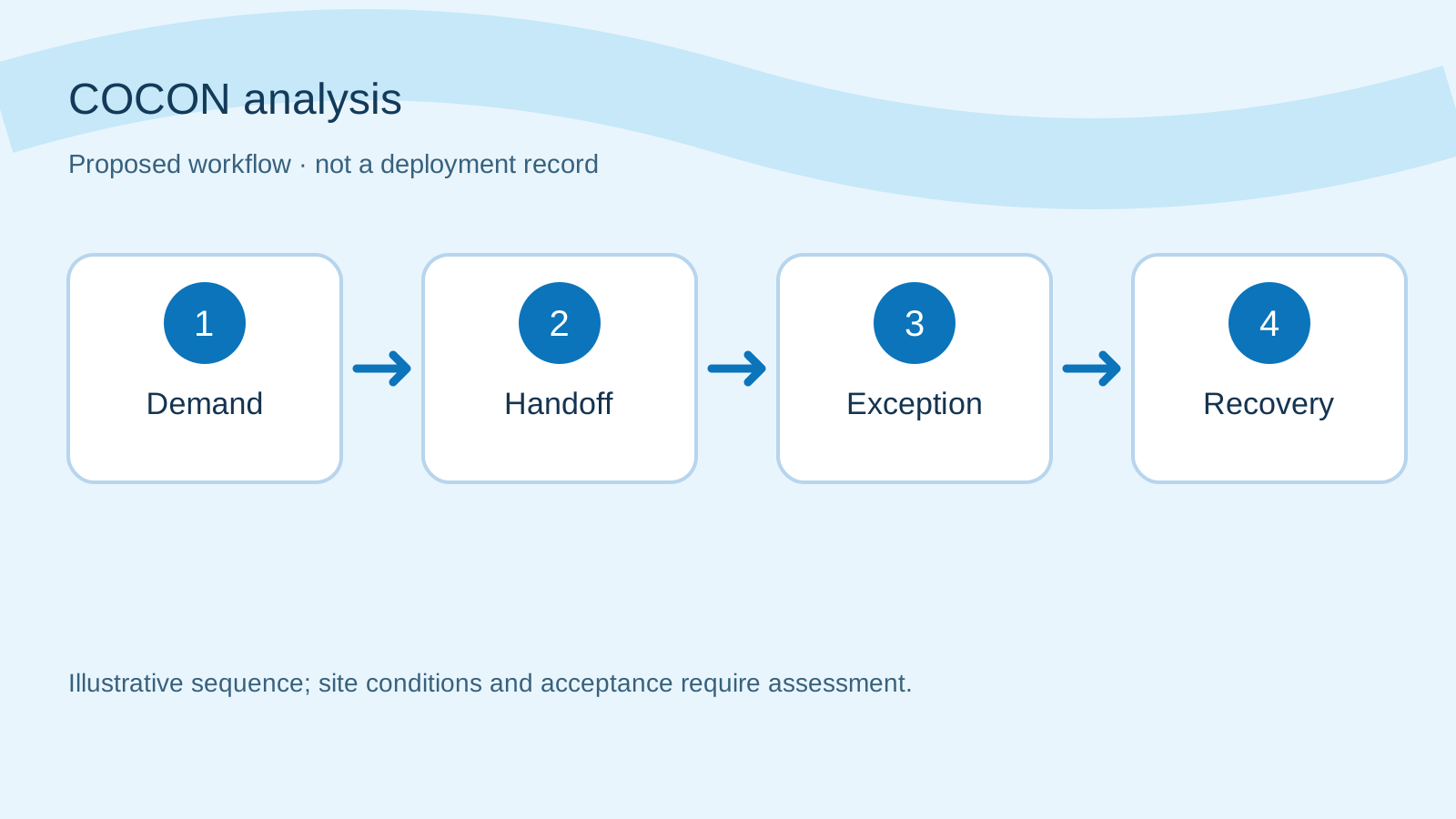
For a concrete example, consider a proposed internal transfer of closed, nonhazardous parts bins between a fixed preparation point and one assembly station. The robot or automation choice is deliberately open. The pilot is about the evidence needed to make that bounded task reliable: demand, pickup, navigation or transfer, receipt, exception, and recovery. A simpler non-AI solution may be preferable if the route and objects are stable. COCON would not add a foundation model merely to make the project match a national headline. Its operational interpretation is to test whether adaptation is actually required and whether the safety boundary remains understandable to operators.
One affected workflow
Begin with the production need, not a robot demonstration. The assembly station asks for a defined bin type and quantity by a needed time. Preparation confirms the bin ID, content and closure. The transfer task starts only when the bin and receiving point are available; arrival must be distinguished from receipt. A receiver confirms identity and condition, and the system records whether the bin was accepted, rejected, or redirected. Empty-bin return is either included explicitly or excluded explicitly.
Map people and equipment in the operating zone. A line operator, material handler, maintenance technician, safety owner and IT owner may all have different reasons to stop or alter a task. Record doorway states, crossing traffic, floor changes, temporary storage, lighting or visual clutter if perception is proposed, and network coverage where communication is required. Define the request at shift handover and after a production change. The task should be useful even when an exception occurs, because production still needs a known manual way to receive parts.
Policy is not deployment proof
The Cabinet strategy is a governmental plan, while NEDO's SI work is a research and development program. Neither is a certification that any particular robot has completed this bin-transfer task. Procurement should request evidence for the specific stage a vendor claims: laboratory test conditions, supervised pilot records, or production logs with the same load and environment. Do not convert an intention to develop into a statement of current availability.
If AI perception is proposed, ask what changed relative to a deterministic trigger or fixed fixture. The proposed model might address variable bin pose, labels, or obstacles, but each such capability needs its own bounded test. A model that performs well on curated images can fail after lighting, packaging or camera position changes. A model update must be evaluated and released through a controlled process. No public policy text can assign the site-specific threshold for false acceptance, missed bin identity, or late arrival. The buyer and operator must choose those thresholds after observing their current workflow and evaluating the consequence of error.
Evidence: AI Robotics Strategy, partially revised 27 May 2026 · Digital Robot Systems Technology Infrastructure Project
System design for one task
Design the transfer as a system of interfaces. The production request has an ID, part or bin type, quantity, origin, destination, due time and cancellation rule. The physical side needs an agreed carrier, pickup fixture, safe operating zone, receiving station, power plan, human interaction and recovery tool. The data side records each handoff, device state, operator override and reason for failure. State transitions should be testable even if a network connection drops or a duplicate request arrives. The receipt event belongs to the receiving process, not merely to the robot's location estimate.
Safety functions need an independent risk assessment and an owner. An AI model's confidence score is not a substitute for a protective stop, an operating-zone rule or a trained person. Decide what the robot does when it cannot determine the bin, when the route is blocked, when the receiver is absent and when power or communications fail. Keep a manual path for urgent parts.
Evidence: Digital Robot Systems Technology Infrastructure Project
Data and responsibility
A data pipeline should start with purpose and ownership. Identify which observations are needed to verify a handoff, diagnose an exception, or improve a proposed model. Record the data source, timestamp, task ID, version of relevant software, and disposition. Avoid collecting unrestricted video merely because a camera is available. Agree retention, access, deletion and sharing rules with the site. If a research partner asks for data, the site must decide what can be transferred and under which authorization; a national policy does not give automatic rights to factory data.
Separate offline learning from live movement. Curate exceptions, label them with accountable human review, test a new model against held-out normal and adverse cases, and approve a release before it controls a physical action. Keep a rollback path and a version record tied to each task. After an update, repeat the relevant acceptance tests. A buyer should make the required level of data governance proportional to the task and consequence of error.
One bounded pilot
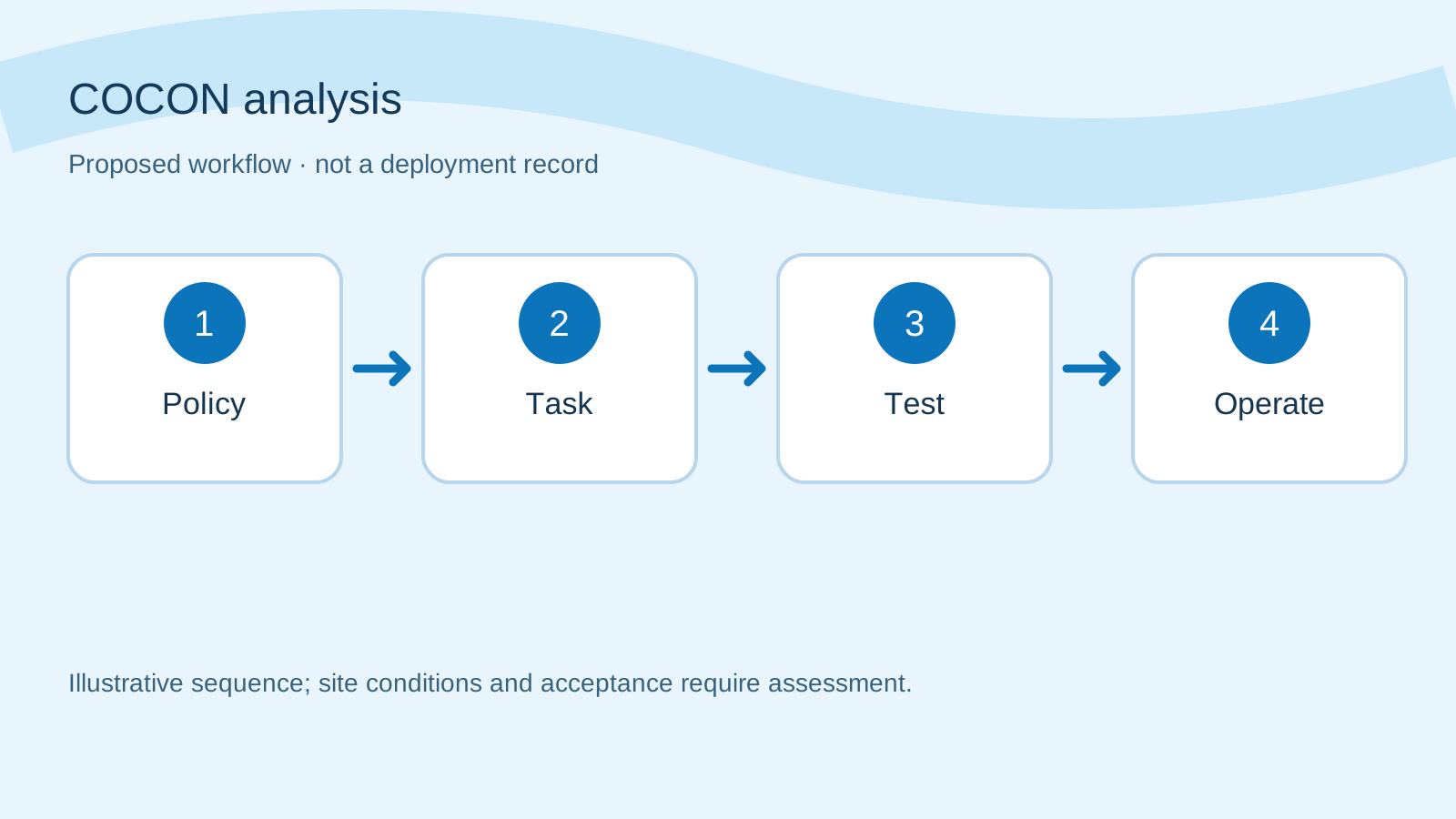
COCON pilot proposal: select one preparation point, one assembly station, one closed bin family and a defined operating window. Do not begin with multiple sites, changing product mixes or unattended shifts. First map the manual flow and assess the zone. Then run an empty-bin supervised trial, a representative loaded trial, and controlled production requests while the manual route remains available. Freeze the task definition for the comparison period. If the bin, route, sensor arrangement or model changes materially, log the change and repeat affected tests rather than mixing results.
Assign a production owner for demand and receipt, a safety owner for the zone, an engineering owner for the interface, a maintenance owner for recovery, and a data owner for logs. These roles can be combined at a small site but must not disappear. Define the end condition before the trial: either the task meets the agreed acceptance sheet, needs a bounded redesign and retest, or is rejected for this setting.
Baseline and acceptance criteria
Observe the existing transfer during the same operating window. Record request release, bin prepared, pickup, arrival, receipt, exception, manual intervention and any line wait. Keep the total number of eligible requests in the denominator, including cancelled and failed ones with reasons. Record the environment during each event: door state, traffic, lighting if relevant, shift and product mix. The baseline should show both timing and error consequences.
Proposed acceptance categories are correct bin and quantity at receipt, traceable state history, completion inside an agreed need window, safe stops at crossings, controlled behavior on uncertain perception or communication loss, and a trained manual recovery without duplicate delivery. The site sets numerical thresholds after seeing baseline variation and completing risk assessment. COCON would report each category separately, along with interventions and failures. Any unsafe movement, lost request identity, unowned recovery or inability to isolate the zone is a stop condition. This is a proposed test design, not a claim that a particular robot has passed it.
Risks and limitations
A policy roadmap may be revised, and a research program may change scope through review. Neither creates a purchase entitlement. A buyer should read the latest official version when making an actual funding or standards decision. The proposed task also has site-specific risks: bins may vary, receivers may be unavailable, network access may be restricted, and temporary obstacles may defeat a route assumed to be stable. Model behavior may drift after a camera, label or lighting change. A safety case must be rebuilt when the operational boundary changes.
The cost and schedule of integration are often less visible than a device quotation. Fixtures, interfaces, data permissions, testing, training, support and manual fallback take time and ownership. No savings or ROI should be inferred from the strategy or NEDO program. The pilot may reveal that the simplest adequate process is a better cart, a fixed transfer mechanism or a better replenishment rule.
Buyer checklist
Ask which task boundary the proposal actually covers and who owns receipt. Ask for the evidence stage: concept, lab test, supervised site pilot or sustained production record. Ask which changes require model retraining or renewed safety review. Ask what data leaves the site, who can read it and when it is deleted. Ask for an interface state diagram including duplicate, cancel, timeout and lost connection. Ask who diagnoses a failed handoff on each shift, and what manual fallback preserves the production need. Finally ask which baseline and stop conditions will be written into acceptance before equipment arrives.
Bring these answers to one cross-functional review. Production, safety, engineering, IT, maintenance and procurement should agree on the same task definition and evidence vocabulary. A roadmap objective is not a site acceptance threshold, and a lab model score is not a delivery result. If a supplier cannot separate those categories, request a narrower trial before a purchase decision. If a simpler tool can satisfy the measured task, document that alternative.
Sources and methodology
COCON reopened the Cabinet Secretariat index and its 27 May 2026 strategy PDF on 21 October 2026. The index also identifies a later August sector-roadmap revision, so this article does not treat the May roadmap as the sole current roadmap. COCON also reopened NEDO's digital robot systems program page, last updated 2 February 2026. These are independent official publishers. Search results and third-party commentary were used only to locate documents, never as the basis for factual claims. Policy text and program aims are identified as such, while the bin-transfer task and tests are COCON proposals.
AI assistance helped organize research, draft, translate and code original explanatory diagrams. The cited statements were checked against the official material on the retrieval date. There is no claim of a named customer, official partnership, stock, return on investment, or achieved robot performance. Before using a real site, the owner must verify current policy, equipment configuration, applicable safety rules, data permissions and acceptance criteria.
Evidence: AI Robotics Inter-Ministerial Liaison Meeting index · AI Robotics Strategy, partially revised 27 May 2026 · Digital Robot Systems Technology Infrastructure Project
Maturity
Government strategy and R&D program; this proposed site task has no published deployment validation.
Limitations
- Policy direction and R&D plans can change and do not certify a supplier or product.
- A site-specific safety case, data permission and acceptance thresholds are still required.
Questions
Does policy support mean a robot is ready for this site?
No. Strategy and program aims need separate task-level tests, risk review and operating ownership.
When would AI add value?
Only when a measured variation cannot be handled adequately by a simpler controlled fixture or rule, and model failure can be tested safely.
Primary sources
- AI Robotics Strategy, partially revised 27 May 2026Cabinet Secretariat, Japan · 2026-05-27
- AI Robotics Inter-Ministerial Liaison Meeting indexCabinet Secretariat, Japan · unknown
- Digital Robot Systems Technology Infrastructure ProjectNEDO · 2026-02-02
COCON used AI assistance for research organization, drafting, translation and original diagrams; factual statements were checked against official primary sources on 21 October 2026.
COCON analysis. Pilot suggestions are proposals, not claims of completed customer projects, partnerships, availability, or guaranteed results.
Related COCON resources
Discuss this workflow
Discuss one defined robotics workflow and its evidence plan with COCON.
COCON Robotics ↗