News signal
Toyota Motor Manufacturing Indonesia reported on 24 September 2026 that its Toyota Indonesia Community Academy, AKTI, graduated 76 students in Karawang. According to the company's release, 44 completed a two-year vehicle assembly operations program and 32 completed a one-year machine and automation maintenance program. Toyota says the curricula were designed around industrial needs and describes an alumnus who later became a team leader at its Sunter engine plant. These facts show a company-run training pipeline, not a measured national robotics skills gap or proof that any graduate can commission a particular robot. For an Indonesian factory considering automation, the useful signal is the explicit place given to maintenance in a vocational pathway. The purchase plan should include who learns to diagnose, restore and safely change the equipment.
Evidence: AKTI Wisuda 76 Lulusan Vokasi Toyota Indonesia Perkuat Sinergi Pendidikan dan Industri Otomotif
COCON operational interpretation
COCON analysis: a robot cell is maintainable only when people, documentation, spare decisions and escalation authority are designed together. Buying a machine before assigning those roles can turn a small fault into a long handoff among operators, electrical technicians, software specialists and vendors. The Toyota release concerns one academy and one cohort; it does not establish a national shortage rate. It does, however, offer a concrete prompt to ask whether a factory's own maintenance team can recover a defined cell without depending on one absent expert. The decision is not whether every technician can program a robot. It is which faults must be recognized locally, which actions are safe to perform, and when the issue must be escalated to a qualified specialist.
Affected maintenance workflow
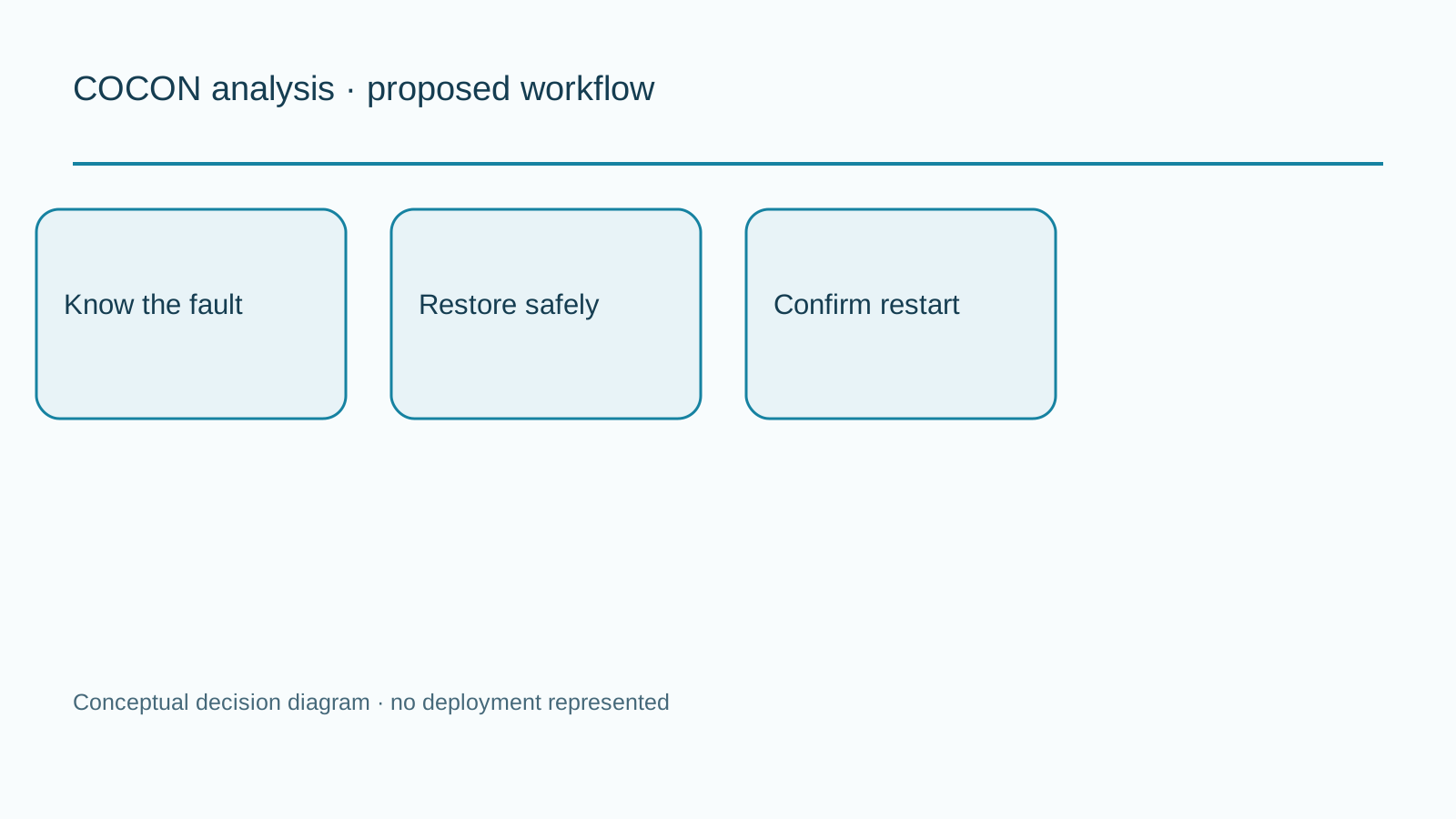
Follow one proposed packaging cell after a planned changeover. An operator sees a stop; the line controller records a fault; maintenance checks the safe state, identifies the affected sensor or sequence, restores the known configuration and tests a representative cycle before returning the cell to production. The workflow is a COCON example, not a reported Toyota installation. Its input is an observable stop with time, product, mode and alarm; its output is a documented restart or escalation. Name the person who may lock out energy, the person who can restore a backup and the supervisor who accepts the return to service. A maintenance course may teach components, but the site still needs a local procedure for its own equipment and hazards.
Maturity of the evidence
The primary source documents a 2026 graduating cohort and describes the academy's intended alignment with industry. It is company-reported education evidence, not a controlled study of technician proficiency, hiring retention, robot availability or plant productivity. The cited alumnus illustrates a career path but cannot be used to infer a typical outcome for the cohort. A factory can regard the academy as an operating vocational program while treating any claimed plant-wide skills effect as unmeasured here. Production readiness of a robot cell belongs to that cell's design, training records and witnessed recovery tests. It cannot be transferred from a graduation count. COCON therefore frames the signal as a planning reminder, rather than a market estimate or promise of workforce supply.
Skills and system design
A useful skill matrix should follow the machine's failure paths. For one cell, list safe isolation, alarm reading, drawing and I/O interpretation, sensor inspection, mechanical checks, backup and restore, configuration control, network diagnosis, controlled restart and escalation. These are proposed categories, not subjects claimed for the AKTI curriculum. Distinguish observation from authorized intervention: an operator may record an alarm, while only trained maintenance staff may enter a guarded area or change a parameter. Store approved backups with version and owner; compare the active program to a known state before a restart. Keep the fault log connected to production conditions so that recurring stops can be separated from one-off mistakes. Training must use the actual interface and safety rules of the chosen site.
Training ownership
Assign a training owner before buying equipment. The production lead defines which interruptions matter; the safety lead approves isolation and intervention rules; maintenance defines diagnosis and restoration tasks; the integrator supplies equipment-specific documentation and supervised practice. Procurement should put deliverables in the contract: readable drawings, alarm meanings, backup procedure, change log, spare identification, and a practical handover test. A signed attendance sheet alone does not establish competence. Ask each trainee to demonstrate the steps, explain why a restart is safe and identify when to stop and call support. The site must decide which shift carries backup coverage. If only the commissioning engineer can recover a fault, the operator-facing process is not yet mature.
One bounded skills pilot
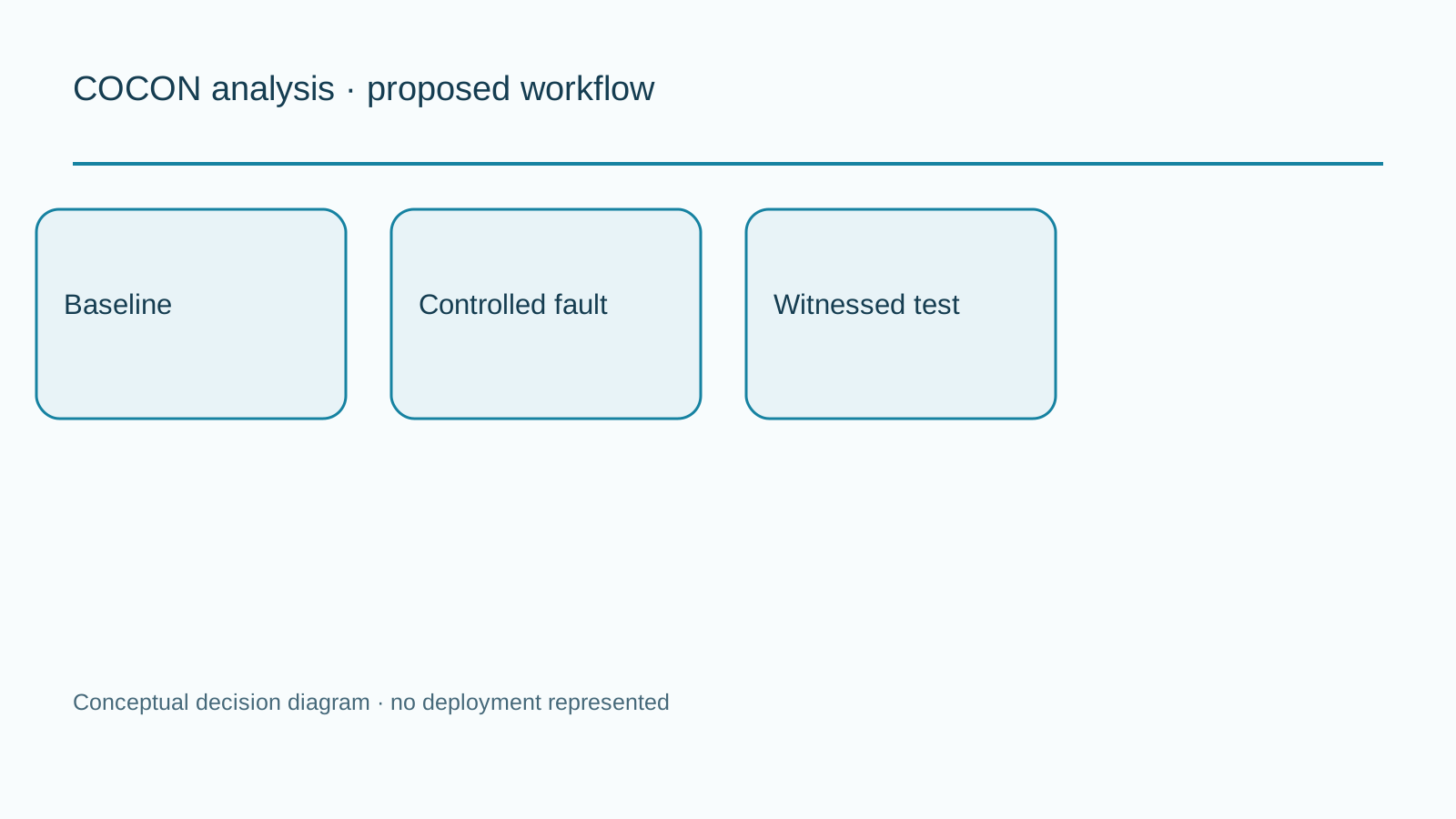
COCON pilot proposal: select one existing or planned automation cell with a bounded production task. Choose two technicians from different shifts and one supervisor to participate in a supervised training cycle. Create a ten-skill matrix against the cell's drawings, safety assessment and backup files. Practice a small set of controlled faults away from live production, including a sensor error, a recoverable communication loss, and a configuration mismatch. Do not bypass guards or inject faults into an uncontrolled line. The site determines training duration after assessing equipment and staff readiness; the Toyota announcement does not supply a universal curriculum length. The pilot ends with a witnessed recovery drill, a signed escalation rule and an updated handover pack rather than an attendance certificate alone.
Baseline and acceptance criteria
Before training, record the time and steps needed for the current team to classify each chosen fault, identify its safe state, find the correct document and escalate. Count wrong or missing backup versions, ambiguous alarms and interventions that require external help. COCON proposes acceptance criteria: both technicians can find the current drawing and backup; they identify the correct safe isolation boundary; they classify each controlled fault without guessing at a parameter; they restore only approved configurations; and the supervisor can verify the restart record. Set any time target after baseline observation, never by assuming a vendor figure. Record unsafe attempts and unresolved questions as failures that need correction. This measures competence for a defined cell and drill, not general employability or national talent availability.
Risks and limitations
This article cannot infer how many Indonesian plants have a maintenance shortage from one Toyota release. Graduation counts say nothing by themselves about later retention, shift coverage, robot types or competence under faults. The academy's own statement about curriculum alignment is a company claim, not independent proof that every graduate is ready for every cell. Site equipment may differ substantially from training equipment. A technician who can replace a sensor may still need specialist help for robot safety configuration or a software integration fault. Conversely, a good vendor manual is not a substitute for practiced recovery. Budget for paid training time, safe test conditions, document updates and retraining after changes. Stop the pilot if the fault cannot be isolated safely or the approved backup is uncertain.
Buyer checklist
Ask who owns each alarm and who can authorize restart on every shift. Can the supplier provide editable drawings, program backups, parameter lists and alarm explanations in a usable language? Which faults can local staff safely resolve, and which require escalation? What response evidence will be available when support is remote? How will a trainee demonstrate competence rather than merely attend a session? Where are backup versions stored and how are changes approved? What happens if the named technician leaves? Which recovery drills will be witnessed before final acceptance? These questions convert a vague promise of training into a procurement and operations requirement. They also reveal where local staff need a specialist, which is a valid design outcome.
Sources and methodology
Method: COCON reopened Toyota Motor Manufacturing Indonesia's official AKTI graduation release on 20 October 2026 and verified the 24 September date, Karawang setting, cohort count, program split, stated curriculum aim and alumnus example. This is a single-company announcement; the article does not generalize its counts to Indonesia's workforce or use them as evidence of robot performance. The hypothetical cell, skill categories, training pilot and acceptance tests are COCON analysis and proposals. Toyota's graduation image has no stated commercial reuse grant, so the diagrams here are original COCON graphics and do not depict actual students or a Toyota facility. A buyer should seek primary records for its own equipment, personnel and safety duties before applying the proposed checklist.
Evidence: AKTI Wisuda 76 Lulusan Vokasi Toyota Indonesia Perkuat Sinergi Pendidikan dan Industri Otomotif
Maturity
An operating vocational education pipeline is reported; no robot-cell performance result or national skills estimate is established.
Limitations
- A graduating cohort does not establish long-term retention or readiness for a specific robot cell.
- The curriculum alignment statement is Toyota’s claim; the release supplies no independent assessment of each graduate.
- The proposed drill needs site-specific risk controls, approved backups and a qualified witness.
Questions
Do 32 maintenance graduates show a national skills shortage?
No. The number describes one AKTI program in one year, according to Toyota Indonesia. It says neither how many technicians other factories need nor how many graduates remain in maintenance roles. A national conclusion would require separate representative evidence.
What should a supplier hand over with training?
Request drawings, alarm explanations, approved program and parameter backups, a change record, a safe isolation procedure and a list of faults that require specialist help. Test whether local staff can use these items during a witnessed drill, rather than counting only classroom attendance.
Can an operator reset every alarm?
No general rule follows from this release. The site must assign permissions after its safety assessment. Operators can record conditions and call maintenance; trained personnel may diagnose or restore specified faults. Uncertain safety settings or backups require a stop and escalation.
How should a buyer compare training offers?
Define the cell, shifts, authorized actions, fault set and acceptance evidence before comparing offers. Ask who teaches, who observes, what documents remain, how updates are handled and how competence is checked after a change. Price alone cannot show whether the handover works.
Primary sources
- AKTI Wisuda 76 Lulusan Vokasi Toyota Indonesia Perkuat Sinergi Pendidikan dan Industri OtomotifToyota Motor Manufacturing Indonesia · 2026-09-24
COCON used AI assistance for research organization, drafting and translation. The Toyota Indonesia announcement was checked on its official page on 20 October 2026; the training example is COCON analysis.
COCON analysis. Pilot suggestions are proposals, not claims of completed customer projects, partnerships, availability, or guaranteed results.