News signal: a company roadmap, viewed in context
In a release dated 21 February 2024, Toyota Motor Manufacturing Indonesia, or TMMIN, described its National Lighthouse Industry 4.0 recognition and the second stage of its own roadmap. It said that stage covered 2022 through 2024 and concentrated on logistics, maintenance and quality. The examples it named included robotic process automation, predictive maintenance, an electronic warehouse, quality inspection and engine traceability. These are Toyota's descriptions of its program, not independent measurements of what each technology achieved.
The date matters. This is a retrospective reading of a 2024 company release, checked again on 19 October 2026, not a new Toyota announcement or a claim that the same stage remains current. The source also describes skills mapping through the Toyota Learning Center. COCON uses the named focus areas as a prompt for a practical decision: how should a different Indonesian plant connect material supply, equipment signals and quality records in one small trial? The answer cannot be copied from a company case description without measuring the local process.
COCON analysis: connect three operating questions
COCON analysis: logistics, maintenance and quality meet at a production handoff. A station cannot make the planned unit if material arrives late; it may make a defective unit if the equipment condition is drifting; and it cannot learn from the failure if inspection results are disconnected from the lot and equipment state. The practical opportunity is a shared evidence trail that lets supervisors see which event happened first. This does not require a large robot fleet on day one. It requires consistent identifiers and a clear response owner.
It is tempting to call every item in a digital roadmap robotics. Toyota's release says robotic process automation, which commonly describes software workflows; the release does not establish that this item is a physical robot installation. Electronic warehouse and traceability are also information and process systems, not necessarily robots. A robotics investment should be justified only where moving, handling or inspecting a physical item is the constrained step. Separating software automation from physical automation prevents a procurement list from replacing a process diagnosis.
Affected workflow: replenishment, machine state, inspection
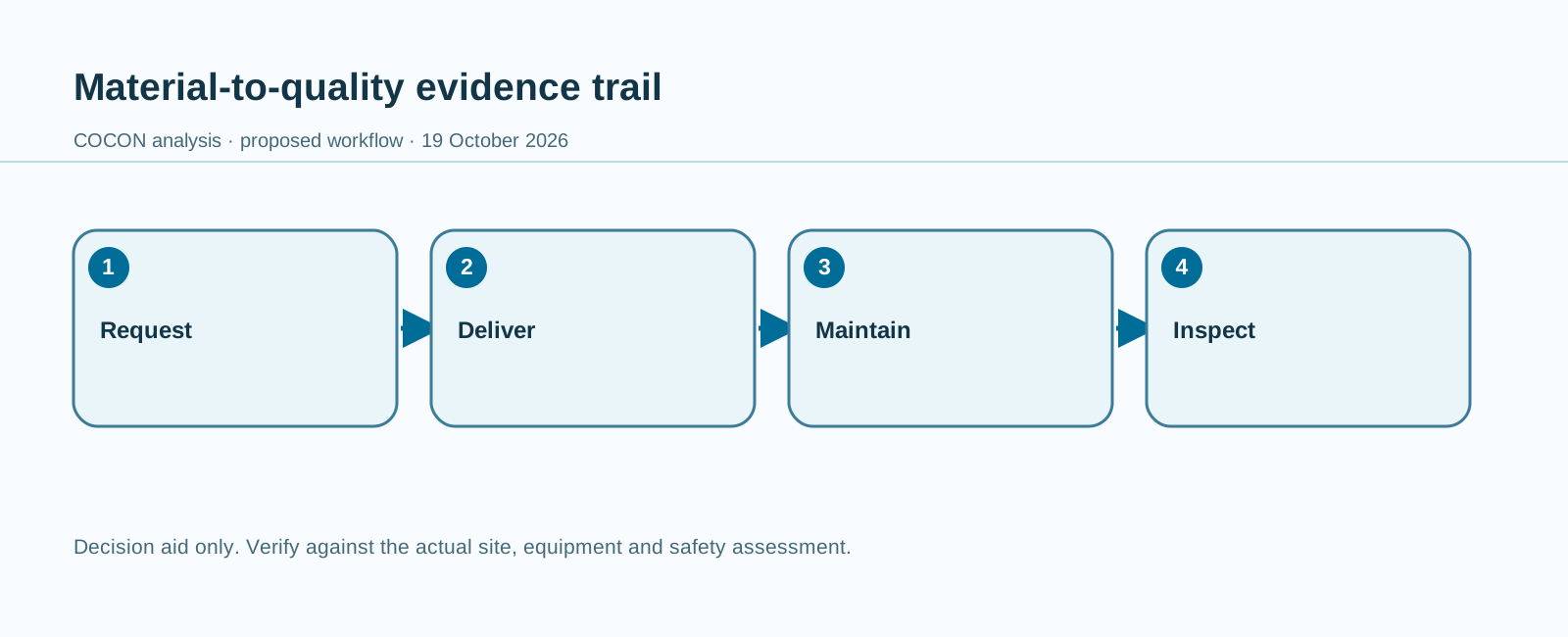
Take a proposed single-line workflow. A production order creates a material requirement; a store or warehouse records the correct lot and sends a replenishment signal; the operator receives the material at a defined point. The equipment records a small set of condition events that maintenance can interpret. A quality checkpoint records the item or lot identifier, inspection result and disposition. If a defect is found, the supervisor can reconstruct which material, machine state and handoff preceded it. This is a proposed design for evaluation, not a description of TMMIN's installed architecture.
Each event needs an owner and a clock. Production planning owns the required quantity and timing. Warehouse operations own the picking and delivery confirmation. Maintenance owns the meaning of condition alarms and the work order. Quality owns defect labels, verification and release. IT or controls engineers own the links among systems, access permissions and time synchronization. Operators need a simple exception path when labels are missing, networks fail or material is substituted. Without these assignments, a dashboard can display disconnected alerts while the physical line still depends on informal calls.
Maturity: recognized program, unknown transferability
The primary release supports saying that Toyota reported a roadmap and recognition in 2024. It does not break down outcomes by technology, publish an independent controlled comparison, or show that another plant can reproduce the program with the same costs and skills. COCON therefore treats the source as evidence of TMMIN's stated direction, not as a performance benchmark for robots, predictive maintenance or vision inspection. Even a mature program elsewhere does not establish readiness for a plant whose data identifiers, equipment interfaces or maintenance practices differ.
COCON analysis: readiness should be assessed at the smallest working boundary. An electronic replenishment trigger may be ready if locations, part numbers and handoff confirmations are dependable. A maintenance signal may still be exploratory if failures are rare or labels inconsistent. A quality checkpoint may require supervised review if images and defect definitions are unstable. These can mature at different rates within one line. The pilot must expose this difference instead of assigning one maturity label to an entire Industry 4.0 portfolio.
System design: identifiers before devices
Start with a map of identifiers: order, part, lot, container, machine, inspection event and timestamp. Agree where each is created, how it is scanned or entered, and which system is authoritative when records disagree. Define a small event contract: material requested, picked, delivered and accepted; equipment normal, alert and restored; inspection passed, held or rejected. A handoff without an explicit acknowledgment remains ambiguous. Put a visible correction process around wrong scans and duplicate events so audit records do not quietly diverge from the physical flow.
Only then choose devices or software. A mobile robot might move a container, but the trial can first use a human delivery with the same event interface to learn whether routing is the bottleneck. A camera might support inspection, but a qualified human label set is needed to understand false rejects and escapes. A condition sensor might help maintenance, but its alert must lead to a defined action rather than a colored chart. Safety and worker training apply to any later physical robot deployment. Data access should be limited by role, and the process should continue in a documented manual mode when the network is down.
One bounded pilot: one line and one material family
Pilot proposal: choose one production line, one material family and one quality checkpoint for six weeks of observation and controlled change. Keep the first phase as a baseline, with current material delivery and inspection decisions recorded under common identifiers. In the second phase, add an electronic replenishment trigger, one equipment-condition signal and an inspection record linked to the same lot. Do not promise that the equipment signal predicts failure; begin by checking whether it is reliable, timely and actionable. A robot is considered only if the measured transport task still justifies it.
The baseline should measure requests delivered on time, line waits attributed to missing material, alarm-to-response time, inspection decisions per lot, false holds found by review, missing trace links and operator correction effort. Define the observation window, shift mix and product mix in advance. Compare like with like; a change in product mix can masquerade as improvement. Assign one supervisor to resolve conflicting records during the trial. Stop automatic routing or inspection decisions if identifiers become unreliable, a quality hold lacks an owner, or an equipment alert creates unsafe intervention.
Acceptance criteria: reward a reliable handoff
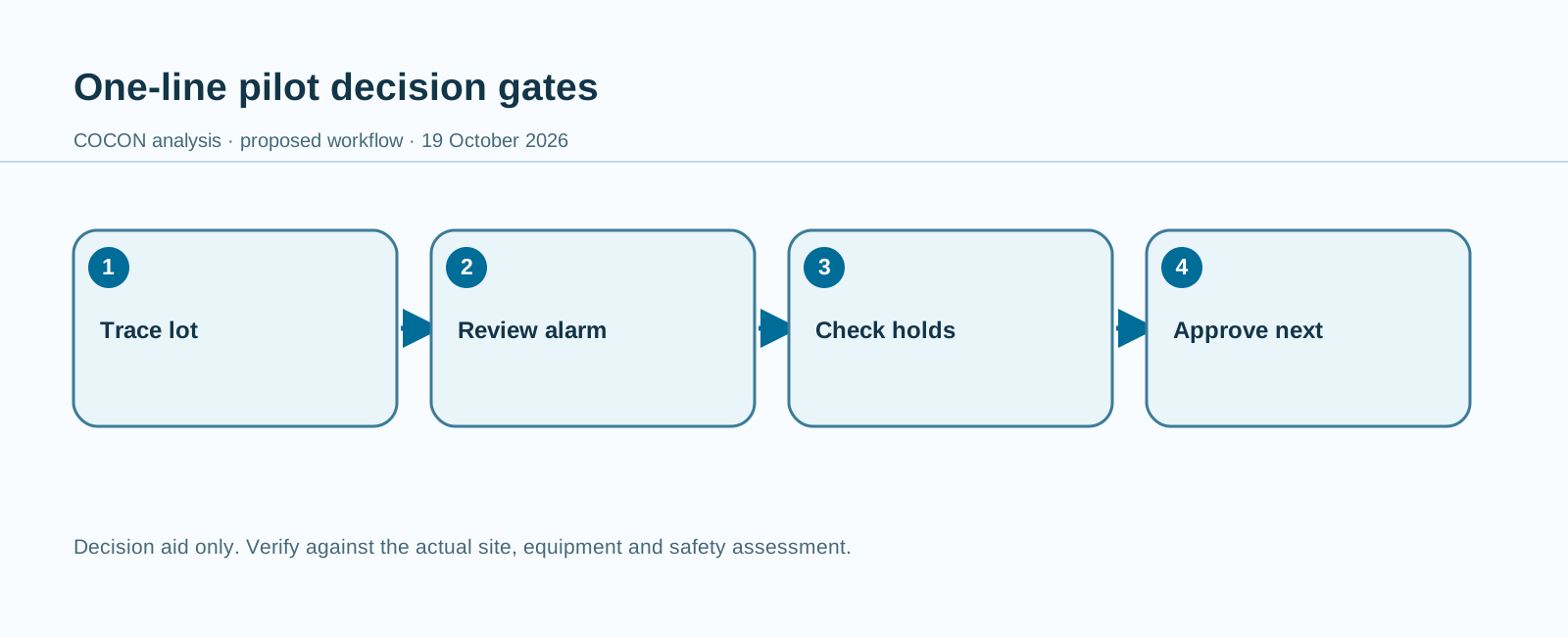
Pilot proposal: require every trial lot to have a reconstructable path from request through delivery to inspection, subject to a pre-agreed completeness threshold. Require material requests to be acknowledged within the line's actual service window and exceptions to have a named responder. Require the equipment signal to be reviewed against maintenance logs before it triggers work automatically. Require an inspection hold to be traceable to the exact item or lot and to permit human correction. The plant should set numerical thresholds from its baseline and quality requirements before viewing results; this article does not supply universal targets.
Review the joint workflow, not isolated dashboard counts. If delivery becomes faster but the wrong lot is scanned, the process is not accepted. If maintenance alerts multiply without useful action, the signal is a burden. If vision inspection catches more candidates but false holds overwhelm review, the checkpoint may need a different threshold or a narrower defect class. Compare exception rates and staff time, including rework caused by data errors. Expand only the part of the chain that meets its acceptance criteria and has an operational owner.
Risks and limits: dependency and false confidence
A linked system can make a plant more dependent on consistent master data and available networks. Incorrect part numbers can propagate from an electronic warehouse event into quality records. A sensor alarm may be correlated with a problem without diagnosing its cause. A quality model can reject good items when lighting or product finish changes; it can also miss defects that were absent from training examples. These are potential failure modes to test, not documented failures at Toyota. Retain a manual fallback and a correction log for each handoff.
The Toyota release leaves implementation cost, interface design, error rates and the contribution of each technology unreported. It also describes one company's context and workforce program. COCON cannot infer a payback period, employment effect or achievable throughput for another site. Buyer teams should budget for label governance, operator practice, maintenance review and data reconciliation before comparing device quotations. A pilot that reveals weak identifiers and unclear responsibility can be valuable even if it delays a robot purchase; it prevents a larger deployment from scaling the same ambiguity.
Buyer checklist, source and methodology
Ask: which physical delay or defect is the first target? Which system creates each identifier, and who fixes a mismatch? How will material, machine and inspection events be joined without guessing? What is the present false-hold and missing-record baseline? Who may overrule an automated signal? What happens during a network or sensor outage? Which safety assessment is needed if a physical robot is added? What evidence would justify a second line? These questions help procurement request a process proposal and acceptance plan rather than a catalog of unrelated devices.
Method: COCON reopened TMMIN's primary newsroom release, published 21 February 2024, on 19 October 2026. Award, roadmap period, stated focus areas and named initiatives are company-reported facts. The event architecture, sequence, six-week pilot and acceptance criteria are COCON analysis and proposals for a hypothetical site. This article makes no claim of a COCON relationship with Toyota, first-hand access to its factory, measured customer result or product availability. Related COCON guides on adoption and integration provide context, while local measurements remain necessary for a purchase decision.
Maturity
TMMIN reported a recognized Industry 4.0 roadmap in 2024; transferability to another site is unverified.
Limitations
- Technology-specific outcomes and implementation costs are not decomposed in the company release.
- RPA in the release does not by itself establish a physical robot deployment.
Questions
Does this prove a robot investment at another plant will pay back?
No. The source gives no transferable cost and benefit calculation.
Why begin with identifiers?
They let teams join material, equipment and inspection events to the same physical item or lot.
Primary sources
- TMMIN becomes Indonesia's Industry 4.0 Role Model for Receiving the National Lighthouse Industry 2024 AwardToyota Motor Manufacturing Indonesia · 2024-02-21
AI tools assisted research, drafting and translation. Company-reported facts were checked against the linked primary release on 19 October 2026; proposed workflow and tests are COCON analysis. No named human reviewer is represented.
COCON analysis. Pilot suggestions are proposals, not claims of completed customer projects, partnerships, availability, or guaranteed results.