News signal: a simulation interface, not a factory result
FANUC's 15 May 2026 announcement describes two directions of integration. In one, Isaac Sim provides the virtual environment while ROBOGUIDE exchanges robot motion and controller behavior with it. The release says a virtual or physical teach pendant can be used for jogging, teaching and executing robot programs inside that environment. In the other direction, ROBOGUIDE uses NVIDIA PhysX for physics-based studies, including random bin picking. These are FANUC descriptions of its own technology; the announcement does not publish an independent, application-by-application error distribution.
The same release describes a dual-arm T-shirt-folding demonstration using imitation learning and a separate Jetson Thor-based demonstration. Those examples show the breadth of the exhibition, but they are not evidence that a prospective buyer's parts, gripper, safety system or takt time have already been validated. This article focuses on one decision: when can a virtual bin-picking study reduce uncertainty before building a cell? It does not infer general production performance from a demonstration.
COCON analysis: define what the model must predict
COCON analysis: the value of a digital twin is a testable prediction, not an attractive rendering. A virtual robot can appear to clear an obstacle while a real cable, gripper jaw or misplaced fixture changes the reachable volume. A predicted cycle can also omit operator replenishment, failed grasps and recovery. The engineering team should therefore write down which quantities must agree between the model and the physical cell before deciding whether virtual commissioning earns a place in the purchase process.
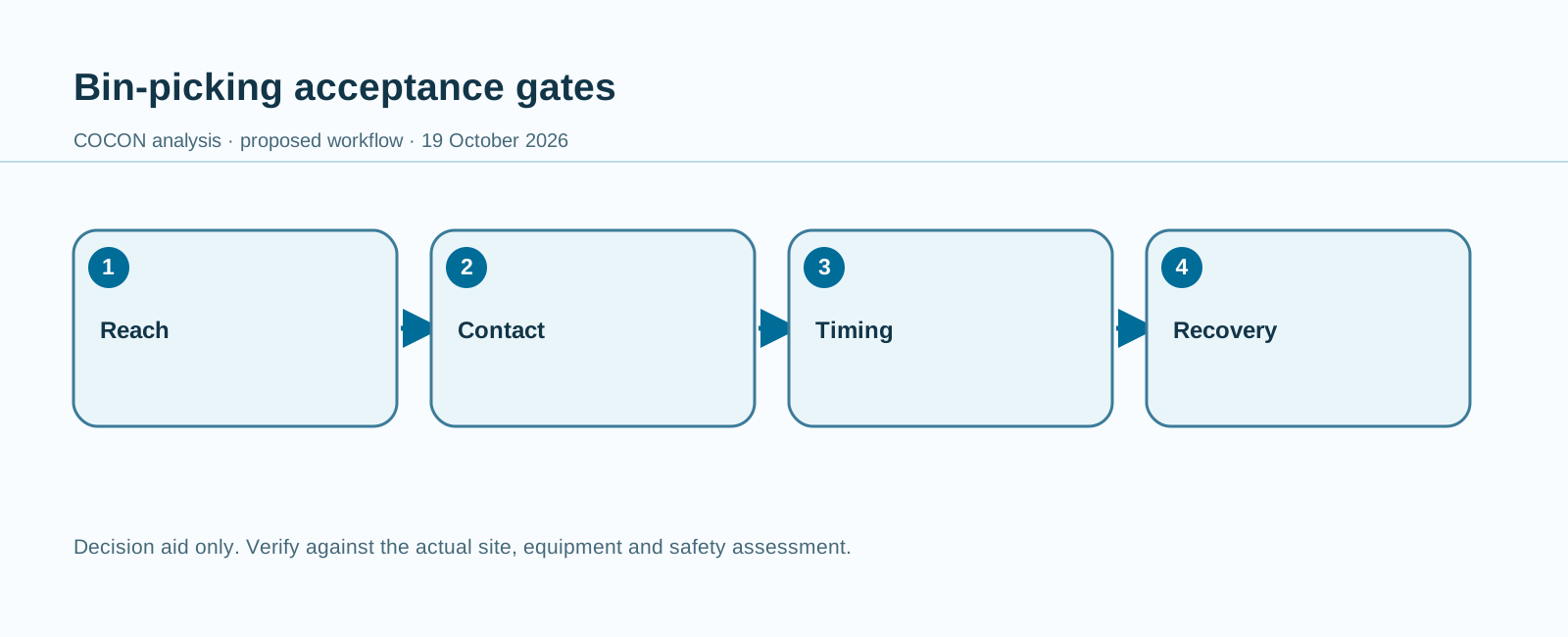
A useful acceptance contract separates three questions. Does the motion model reproduce reachable poses and path timing within a pre-agreed tolerance? Does the contact model identify when piled parts cannot be separated or gripped? Does the resulting design permit safe, understandable recovery when the prediction fails? A single pass/fail score hides these different failure modes. Each question needs its own baseline, measurement method and owner. COCON proposes this decision structure; FANUC did not publish these particular acceptance criteria.
Affected workflow: from part sample to released pick
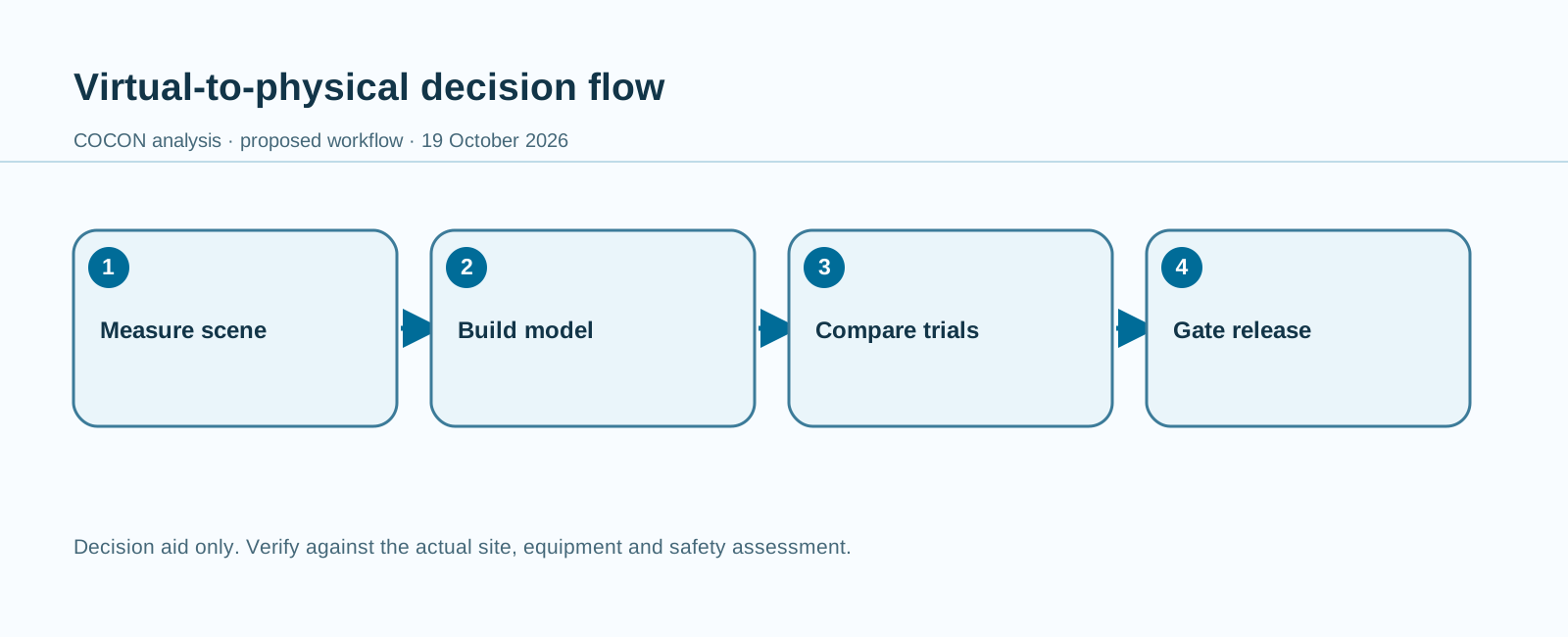
Consider one proposed bin-picking workcell, not a claim about any existing COCON customer. Incoming parts arrive in a container with varying pose and overlap. A sensor produces a scene estimate, a planner proposes a grasp, the robot moves with a fitted tool, and the cell confirms whether the part reached the output fixture. Failed recognition, failed grip and blocked extraction are separate exceptions. The operator needs a defined route for each exception; otherwise a plausible simulation may conceal manual intervention.
The handoffs are as important as the robot motion. Process engineering owns the allowed part mix and fixture geometry. Controls engineering owns interlocks and communication with upstream and downstream equipment. Maintenance owns calibration and wear checks. Operations owns bin replenishment, exception clearing and shift records. Safety personnel approve the physical risk assessment. The simulation owner records model version, dimensions, friction assumptions and software configuration, so a design decision can be traced back to the assumptions that produced it.
Maturity: vendor demonstration versus site qualification
The public source is a vendor announcement about strengthened software integration and exhibition demonstrations. It supports describing a demonstrated integration and proposed application studies. It does not give a buyer a certified envelope for every part material, pile condition, sensor or gripper. FANUC's statement that trajectories and cycle times can match real machines should be treated as a vendor claim to verify on the exact hardware and program. Contact behavior is especially dependent on inputs that are difficult to observe from a screen.
COCON analysis: readiness is local to the task. A path simulation may be useful for layout and reach studies before its collision and contact predictions are trusted for final process acceptance. A successful staged test could justify a narrow pilot without proving broad autonomy. Procurement should ask which functions are generally offered, which are demonstration configurations, and which require application engineering. The answers need current written scope from the supplier; the May announcement alone is insufficient proof of delivery terms or availability.
System design: keep data and safety boundaries explicit
A useful model begins with surveyed coordinates of the bin, fixtures, guarding, robot base and tool center point. It needs a versioned robot program, controller settings, camera calibration, part geometry and the distribution of actual incoming poses. For bin picking, the study should state how contact, friction, pile settling and occlusion are represented. An unknown parameter is an uncertainty to test, not a number to choose until the animation looks convincing. Store the simulated scene and the physical trial record under the same part and configuration identifiers.
The production control design must remain independent of simulated confidence. A virtual clear path cannot replace physical guarding, risk assessment, protective devices, emergency stop design or operator training. A low-confidence grasp should route to a supervised exception rather than silently retrying forever. The cell should log recognition confidence, attempted grasp, outcome, intervention reason and elapsed time without collecting unnecessary personal data. The integration owner should also document what happens when the simulation software, vision link or network is unavailable.
One bounded pilot: one bin, one part family
Pilot proposal: choose one stable part family, one bin size, one gripper and one output fixture. Freeze the selected hardware and model versions for an initial comparison. Gather a representative physical sample of normal and difficult bin states before changing the algorithm. Build the virtual scene from measured geometry, then ask the model to predict reach, pick sequence and cycle-time distribution. Run 200 physical cycles only after the cell passes its separate safety approval; the number is a proposed sampling plan, not a published FANUC result.
The baseline should include the present manual or existing automated process: completed good picks per hour, interventions per 100 attempts, recovery time, changeover time and any damaged parts. Record the bin fill level and part orientation beside each cycle, because averages across different conditions can mislead. Compare virtual predictions with the same physical configurations, including failed attempts. The pilot must stop for a protective-device fault, repeated unplanned contact, unclear operator recovery or evidence that the model no longer represents the fitted tool.
Acceptance criteria: a decision table before the trial
Pilot proposal: set tolerances before seeing the results. For example, require no unpredicted fixture contact; require all tested target poses to be reachable within the agreed position tolerance; require the median and upper-tail cycle-time errors to stay inside limits set by process engineering; and require each failed pick to produce an identifiable exception and a safe recovery path. These are proposed categories, not universal numerical thresholds. The buyer and integrator should fill in thresholds from the actual product, takt requirement and risk assessment.
Review outcomes by scenario rather than reporting only an overall success percentage. Separate empty-bin, full-bin and partially occluded states; normal and deliberately difficult part poses; and runs before and after a calibration check. Keep a list of misses where simulation predicted success but physical picking failed. Those misses are more informative than photorealistic screenshots. If the model cannot explain a material cluster of misses, use the pilot to improve assumptions and retest before relying on virtual approval for a later cell.
Risks and limits: the model ages with the cell
The largest risk is treating model fidelity as a fixed product attribute. A replaced camera, worn suction cup, new part coating, different bin supplier or shifted fixture can change physical behavior while the saved virtual scene remains unchanged. Contact-rich tasks are sensitive to such changes. A maintenance or change-control plan should say which changes trigger recalibration, model revision and physical requalification. Keep both failed and successful runs; selecting only clean examples would overstate confidence.
Another limit is organizational. Simulation specialists may understand scene parameters that shift supervisors never see. Operators can be asked to recover failures that were excluded from the digital study. Procurement may compare licensing quotations without including model upkeep, calibration labor or access to the necessary interfaces. None of these uncertainties is resolved by the FANUC announcement. The point of the pilot is to expose the cost and responsibility of keeping virtual and physical states aligned, not to promise a return on investment.
Buyer checklist and sources
Ask the proposed supplier and integrator: which robot, controller, ROBOGUIDE and Isaac Sim versions are in scope? Which motion and contact quantities can be exported for comparison? How are calibration and model changes logged? What source data is needed for a representative bin study? Which exception paths require a human? Who signs the physical safety assessment? What breaks when a sensor or network connection fails? What evidence would justify expanding beyond the first part family? Request written answers against one actual workcell design rather than a generic demonstration.
Method: COCON reopened FANUC's primary release, published 15 May 2026, on 19 October 2026. Reported software functions and demonstrations above are attributed to FANUC. The workflow, baseline, decision table and pilot are COCON analysis and proposals, not observed deployments. No performance claim about a customer, supplier relationship, product availability or investment return follows from the source. The linked COCON insights on physical-AI factory data and robot learning give adjacent context; the decision here remains specific to a measurable virtual-to-physical comparison.
Maturity
Vendor-demonstrated software integration; site-specific bin-picking performance is unverified.
Limitations
- No independently reported error distribution for a buyer-specific cell.
- Physical contact, calibration and operator recovery require local validation.
Questions
Does the release prove zero sim-to-real error?
No. That is a vendor description, not an independently published result for a particular cell.
What should be measured first?
Measure the existing pick and recovery distribution, then compare paired simulated and physical cases.
Primary sources
- FANUC Strengthens Collaboration with NVIDIAFANUC Corporation · 2026-05-15
AI tools assisted research, drafting and translation. COCON analysis labels proposals; factual statements were checked against the linked primary source on 19 October 2026. No named human reviewer is represented.
COCON analysis. Pilot suggestions are proposals, not claims of completed customer projects, partnerships, availability, or guaranteed results.