News signal: what FANUC actually announced
FANUC's 18 May 2026 release introduced the DR/8-16B Stainless parallel-link robot for food handling. The manufacturer states an 8 kg payload, a 1,600 mm operating diameter, stainless steel on exposed metal exterior parts, fewer exposed bolts, and an arm designed without horizontal liquid-collecting surfaces. It assigns the arm an IP69K protection rating for high-pressure washdown. FANUC said mass production would start in August 2026 and described battery-less pulse-coder support as planned for October 2026. Those are manufacturer statements about a robot model, not evidence of a validated food-production cell at any named site.
The news matters because the mechanical cleaning boundary becomes visible at the product-selection stage. A buyer can ask about reach, load, exposed surfaces and wiring before specifying a line. Yet the published release does not supply a complete sanitation procedure, compatibility matrix for a site's chemicals, microbiological results, or a measured restart time after cleaning. Treat those as open engineering questions. This article uses the announcement as a prompt for a whole-cell acceptance plan, rather than treating a product feature list as a ready-made food-safety assurance.
Evidence: Long reach all stainless steel parallel link robot for the food industry DR/8-16B Stainless
COCON analysis: the cleaning path is the production path
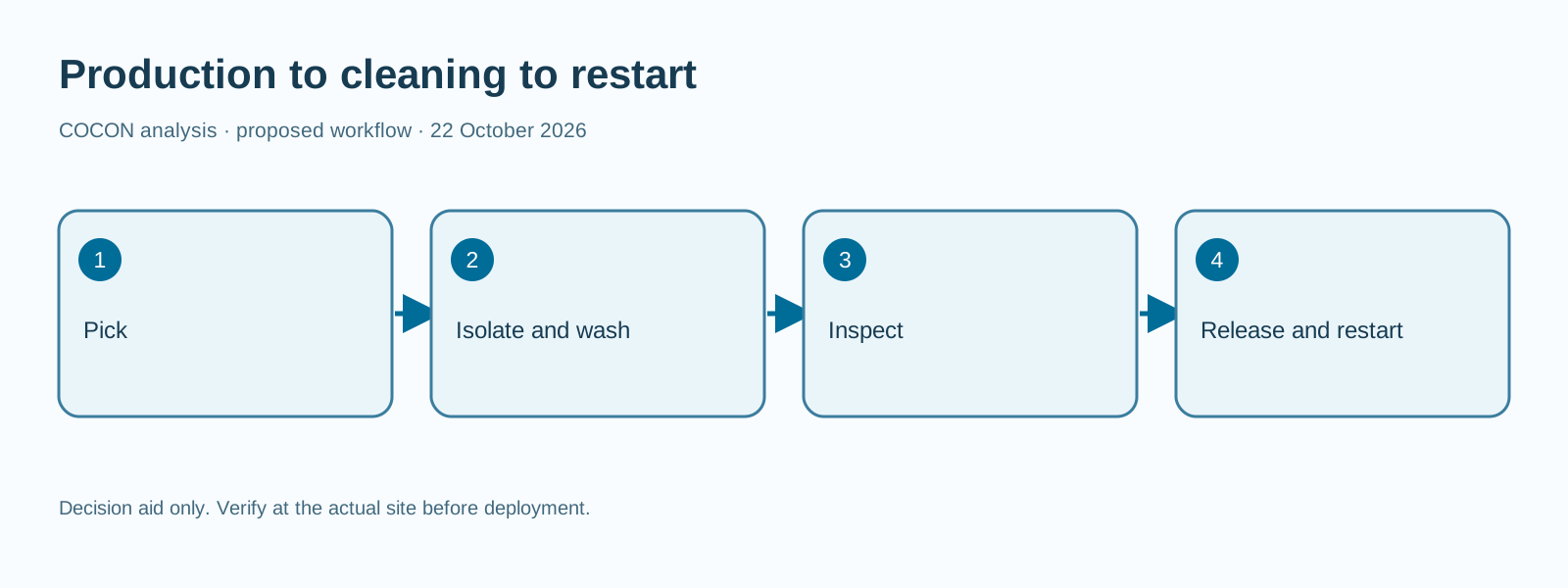
COCON analysis: in direct food handling, the useful unit of evaluation is a repeatable production-to-cleaning-to-production cycle. A fast pick during an ideal dry trial can be irrelevant if residue collects at an inaccessible bracket, the gripper must be dismantled every shift, or the operator cannot confirm that all wash water has drained. Likewise, a clean-looking arm does not establish that a conveyor underside or cable entry can be inspected. An acceptance study should trace the product and the cleaning liquid through the same physical space, with named people responsible for each handoff.
The purpose is to reduce uncertainty before purchasing or specifying a wider line. Start with a map of soil sources, contact and splash zones, drainage, inspection access, rejected product, and the first saleable product after restart. Mark which claims come from FANUC's arm release and which are site-specific hypotheses. The final choice may be to change a gripper, guard, belt or floor drain even if the robot itself is suitable. No single robot protection rating establishes hygienic performance for its surrounding equipment.
Affected workflow: one unwrapped pick and transfer
Consider a proposed pilot in a Japanese food plant that transfers one unwrapped item from a known infeed presentation to an outfeed position. The item and line are hypothetical; COCON does not present a customer installation or a tested recipe. Incoming product must be identified, placed inside the permitted pick window and rejected when its position or condition is outside that window. The robot tool makes contact, the part moves, and an independent downstream check confirms whether it arrived in the correct state. Cleaning interrupts this flow; the shift lead decides when the cell is isolated, cleaned, inspected and released to resume.
Write the workflow as states, not just coordinates. Record product present, tool clean, guards closed, operator access requested, wash mode, dry and inspected, first-piece check, normal running, and exception recovery. Define what each control signal means and who can override it. Include an ordinary missed pick and a product fragment lodged near a fixture; both may require different safe responses. The pilot should show whether operators can understand these states during a real shift, with the published arm specification used only as a candidate equipment input.
Maturity: a production announcement is not site acceptance
FANUC's release gives a stated mass-production start and design details for the arm. It does not report a third-party audit of this particular model in the proposed cell, and it does not demonstrate that a selected tool, mounting frame or cleaning agent passes a site's approval. The correct maturity description is therefore manufacturer-announced product maturity with application qualification still pending. The battery-less pulse-coder item was described as an October 2026 availability plan; this article does not infer that a specific delivered unit includes it. Ask for the exact configuration and current documentation during procurement.
The IP69K claim is also bounded: the release attributes that protection to the robot arm design. It cannot be silently extended to a connector that an integrator adds, a camera mounted inside the cell, or a motor on the conveyor. A buyer should request component-by-component ratings, installation conditions and any excluded cleaning directions. An integrator and the site's quality function must then decide what evidence counts for the assembled system. This separation is useful even when the product is commercially mature, because a known model can still be unsuitable for a particular sanitation process.
Evidence: Long reach all stainless steel parallel link robot for the food industry DR/8-16B Stainless
System design: trace every surface and interface
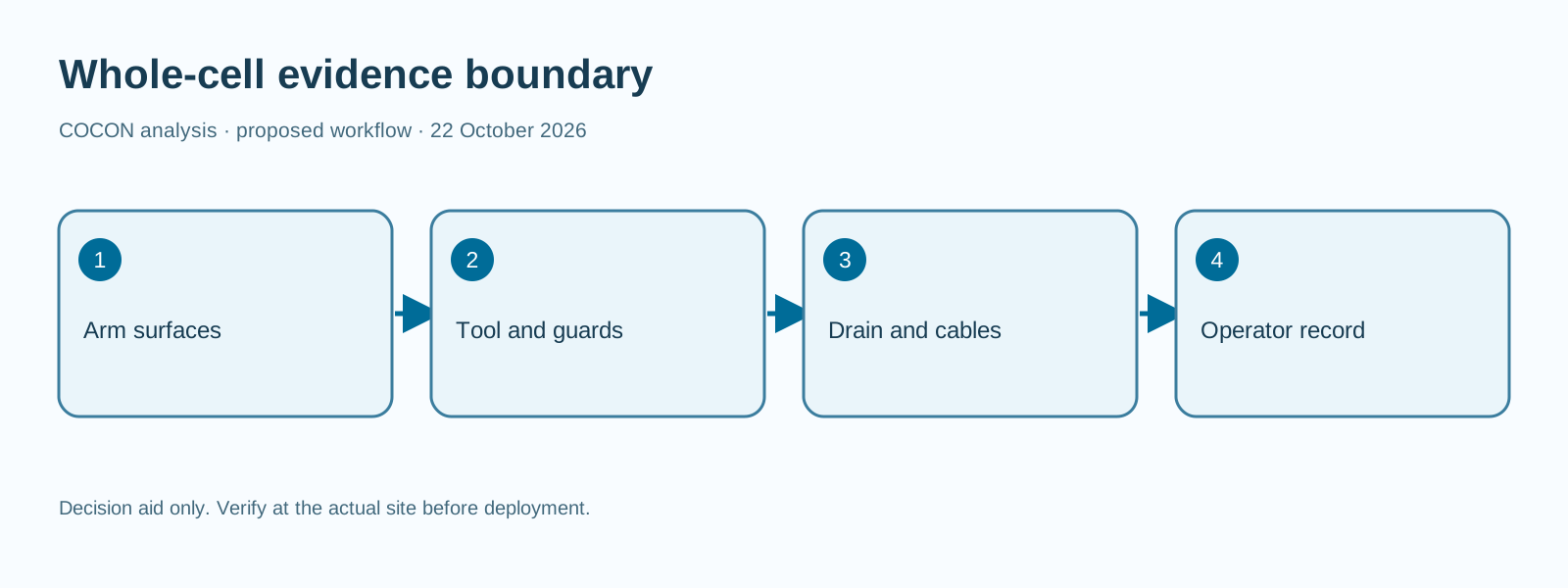
A cell design review should start with the actual food, its packaging state, allowable contact materials and the site's cleaning method. Draw a boundary around the robot, gripper, product-contact tooling, conveyor, guides, drains, guarding, cables, sensors and service access. Identify surfaces exposed to splash and surfaces hidden during normal operation. For each, specify the soil likely to accumulate, the cleaning action, the inspection method, and the person who signs off. Require a change record whenever a bracket, fastener, seal or tool is revised after qualification. This is a proposed review method, not a claim that COCON has validated a specific design.
Controls need a similarly explicit boundary. The production controller should know when picking is permitted; the cleaning procedure should prevent unexpected motion; maintenance must know how to isolate energy before reaching the tool. If water or chemistry can reach an added camera or connector, its own installation evidence matters. The strongest specification is one that allows a maintenance technician to reproduce the inspection without relying on the designer's memory. Place cleaning and recovery instructions where operators actually work, then observe whether the instructions match what they can see and reach.
One bounded pilot: one item, one tool, one cleaning regime
COCON pilot proposal: choose one unwrapped product, one representative presentation, one tool and one defined cleaning regime. Obtain quality and safety approval for the study before running product through a live food line. Use a short supervised comparison with the current method, including the ordinary end-of-shift cleaning, rather than a demonstration that runs only between washes. Freeze the robot, gripper, guarding and chemistry configuration for the initial measurement window. Document any deviation, since changing a tool mid-trial can make the before-and-after record meaningless.
The trial should include a complete cleaning cycle, inspection and controlled restart. Challenge the cell with permitted product variation, residue at expected collection points, a deliberate missed pick, and an operator access request. Do not intentionally create unsafe contamination. Quality personnel select safe challenge materials and acceptance procedures. Stop the run for an unexpected contact, uncontrolled motion, inaccessible soil, unexplained liquid pooling, or an exception that cannot be cleared under an approved method. A successful trial would establish evidence for this one configuration; it would not prove all foods, chemicals or shifts are covered.
Baseline and acceptance: count the whole cycle
Before automation is compared with anything, collect the present process baseline across normal shifts: good transfers, rejected or damaged items, operator interventions, cleaning labor, elapsed sanitation time, inspection findings and time to release the first accepted product after restart. Separate planned cleaning from unplanned clearing. Record product mix and line conditions so the results can be interpreted. Where a baseline measure is unavailable, say so and design the pilot to collect it instead of filling the gap with a supplier's generic throughput figure.
Set acceptance criteria before seeing results. Proposed categories are correct placement without product damage, no inaccessible residue after the approved wash, drainage and dryness at identified inspection points, successful safe isolation during cleaning, documented recovery from each test exception, and an agreed maximum time from shutdown to approved restart. The site must choose its own limits based on food-risk assessment and production requirements; this article supplies no universal pass number. Keep failed trials and their causes in the record. A clean average can hide a rare but operationally important sanitation or recovery failure.
Risks and limits: chemistry, tooling and evidence gaps
The first risk is assuming stainless exterior surfaces guarantee compatibility with the site's actual chemicals, concentration, temperature and exposure time. Obtain written component and seal compatibility information for the specified configuration. The second is transferring an arm rating to accessories. A suction cup, vacuum line, camera housing or cable gland can become the weak point even when the arm is designed for washdown. The third is treating reach and payload as proof that a delicate or irregular item can be gripped without damage. Validate the tool and product condition in the cell, not in an abstract motion study.
There are operational limits too. Added guards may obscure inspection; overhead equipment may redirect water to a hard-to-see point; faster nominal motion may increase jams at the outfeed. A cleaning procedure that works with a specialist present may not work on a late shift. The announcement provides no independent field failure distribution, sanitation-labor data or audited food-safety outcome. COCON makes no estimate of payback or availability. The buyer should reserve the option to reject the cell design or narrow the application when the site evidence does not meet the agreed standard.
Buyer checklist: questions before a purchase specification
Ask the equipment and integration team these questions in writing. Which exact arm and controller configuration is proposed, and which claims are documented for that configuration? What gripper materials contact the food, and how are they inspected? Which surfaces require disassembly to clean? How do water, residue and product fragments leave the cell? Are every added sensor, cable entry and tool rated for the actual wash method? Who owns lockout, cleaning release and first-piece checks? What happens on a missed pick or a detected foreign object? What record will show cleaning and restart over several representative shifts?
Ask for a drawing that marks contact, splash and non-contact areas, plus a trial protocol tied to the site's quality system. Request a list of excluded chemicals and maintenance items rather than an unqualified statement of washdown capability. Seek a clear division of responsibility among OEM, integrator, quality, safety and operations. The answers should determine the pilot design and the purchase specification. If a supplier cannot provide a specific answer, record it as an open issue with an owner and a date; do not quietly assume the line team will solve it after installation.
Sources, methodology and next decision
Method: COCON reopened FANUC's English release and its Japanese counterpart on 22 October 2026. Both are the same company's primary account, published 18 May 2026, and together support only the manufacturer-specific facts attributed above. No separate source was used to infer a broad Japanese market trend. The workflow, baseline and acceptance structure are COCON analysis and pilot proposals. The announcement's August mass-production date and October feature plan are reported as FANUC statements, not independently confirmed unit availability. No manufacturer photograph was reused because the source page provides no verified commercial editorial license for COCON.
The next useful decision is a site assessment, not a generic speed comparison. Bring one product, one cleaning procedure, the tool concept and the current shift record to a discussion with engineering, sanitation and quality staff. COCON can propose workflow assessment, robot selection, pilot scope, integration planning, deployment coordination, operator training and support planning; this is a proposed service, not a claim of a completed deployment. The engineering approach and related Japan use cases provide context. A bounded pilot should proceed only with named owners and written pass, stop and escalation conditions.
Evidence: Long reach all stainless steel parallel link robot for the food industry DR/8-16B Stainless · 食品市場向けロングリーチのオールステンレスパラレルリンクロボット DR/8-16B Stainless
Maturity
Manufacturer announced mass production of the arm for August 2026; the assembled site cell has no verified acceptance evidence in the release.
Limitations
- Arm protection does not certify the whole cell or cleaning chemistry.
- Published material does not provide independent sanitation outcomes or site-specific economics.
Questions
Does IP69K approve the whole food line?
No. FANUC rates the arm; assess the cell.
What should the first pilot measure?
Measure the complete pick, wash, inspection and restart cycle against a recorded current-process baseline.
Primary sources
- Long reach all stainless steel parallel link robot for the food industry DR/8-16B StainlessFANUC Corporation · 2026-05-18
- 食品市場向けロングリーチのオールステンレスパラレルリンクロボット DR/8-16B StainlessFANUC Corporation · 2026-05-18
AI assistance supported research, drafting and translation. COCON analysis and pilot proposals are labeled. The cited manufacturer pages were checked on 22 October 2026; no named human reviewer or first-hand deployment is claimed.
COCON analysis. Pilot suggestions are proposals, not claims of completed customer projects, partnerships, availability, or guaranteed results.
Related COCON resources
Discuss this workflow
Discuss one product and one cleaning cycle with COCON through the contact route.
COCON Robotics ↗