News signal: Japan divides baggage loading into three tasks
NEDO announced its baggage-loading challenge on 2 April 2026. Its stated aim is to develop methods for identifying bags, choosing a loading arrangement, and physically placing varied baggage in an aircraft container or constrained loading space. The agency links the challenge to ground-handling labor pressure and physically demanding work. This is a development program, not evidence that a production-ready loading robot has been installed at an airport. Its three contest streams are useful because they expose separate failure modes that a single impressive demonstration might conceal.
NEDO opened the algorithm contest on 7 July, after the identification and robot contests. Its July notice says the algorithm must choose safe and stable placement and communicate the sequence to a robot. A separate NEDO screening notice says passing the initial review for identification or manipulation was not an award decision. As of this 23 October source review, the algorithm screening window had closed on 19 October, while the July timetable placed result notification in November. We therefore describe a program in progress and avoid assuming a winning or deployable system.
Evidence: NEDO Challenge, Baggage-Loading Robot call · New call for baggage-loading algorithm contest · Screening results for baggage identification and loading robots
COCON analysis: an interface problem before a robot problem
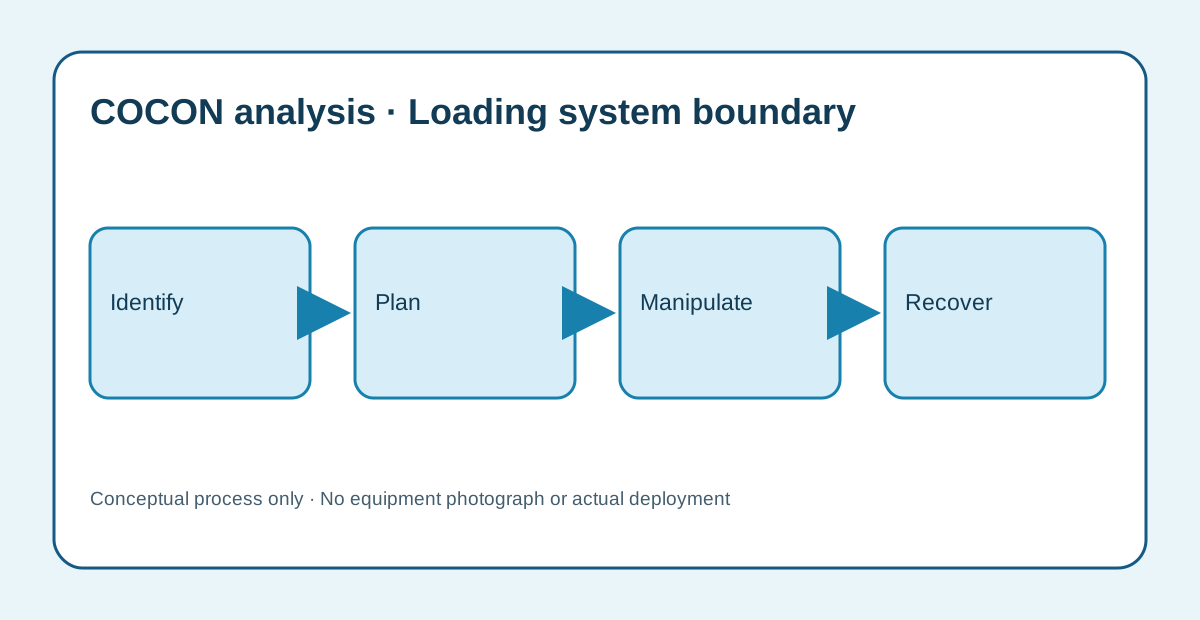
COCON’s operational reading is that baggage loading is a chain of decisions, each with a different kind of uncertainty. The identification layer must provide dimensions, orientation clues, material or handling restrictions, and a confidence signal. The planner must turn those observations into a feasible placement sequence under space and stability constraints. The manipulator must execute that sequence without damaging a bag or disturbing the stack. A safe recovery path must exist when a bag does not match the model. The entire chain needs an accountable operator, even if individual movements are automated.
This interpretation goes beyond NEDO’s announcement. It is a proposed design lens for buyers and engineers, not a report of a COCON installation. The practical implication is to test each interface with known inputs before evaluating the complete cell. Interface tests should include the actual gripper and planner constraints.
Affected workflow: from accepted bag to confirmed placement
Define the first workflow at the point where a bag enters a controlled test area after normal acceptance and tagging. Record its identifier, dimensions, visible handling exceptions, and the target container. The proposed system then chooses a candidate placement, checks whether the pose is reachable and stable, commands the pick and placement, and records the final result. A failed identification, grip, placement or confirmation should pause that item for a named human decision. The pilot ends when the load plan and actual container state agree, not when a robot merely releases a bag.
The boundary matters because airport ground handling includes many adjacent processes: baggage sorting, transfers, aircraft turnaround, container movement, and safety control around people and vehicles. Bringing all of them into an early trial would make a failure hard to diagnose. A mock container outside operational airside space can preserve the geometry needed for learning while removing live-flight pressure. An airport operator would still need to set site-specific safety, liability, access and handling requirements before any operational trial. The workflow here is a proposed experiment, not a promise that the challenge technology is ready.
Maturity: research contest, then integrated demonstration
The NEDO documents establish a public research-and-development challenge. They do not establish an independently measured bag-damage rate, sustained loading rate, supported bag population, or airport acceptance. Screening means proposals met a threshold for continued evaluation; it does not mean a manipulator passed an operational acceptance test. The July algorithm contest was still scheduled to move from screening into later assessment. The separate timelines also mean it is premature to infer that a winning identifier, planner and robot have operated together as one validated system.
COCON would separate maturity into four evidence levels. First, component tests show the identifier, placement algorithm and gripper each meet a declared test set. Second, a combined mock-up shows that their interfaces survive real sensor noise and changing bag order. Third, a supervised pilot tests a representative shift pattern with documented exceptions and operator intervention. Fourth, an operational service demonstrates repeatability under the airport’s actual safety and turnaround rules. None of those later levels follows automatically from a contest announcement or a prize. Procurement language should state the level reached and the evidence still missing.
Evidence: NEDO Challenge, Baggage-Loading Robot call · New call for baggage-loading algorithm contest · Screening results for baggage identification and loading robots
System design: data, mechanics and people must agree
A candidate cell needs more than a robotic arm. It needs a controlled infeed, sufficient camera or sensing views, calibrated coordinates, a bag identity record, a placement planner, a gripper with appropriate contact surfaces, a robot controller, container position confirmation, an exception station, and an operator interface. The planner’s output must use the same coordinate frame and load constraints that the robot can execute. The final scan or observation should compare intended placement with the actual bag and stack. Without that confirmation, a software success message can hide a missed grip or unstable placement.
Safety design begins with the test area and change control. People need a clear stop procedure, guarded entry, a manual recovery path and authority to reject unsuitable bags. Engineers should document what happens when a label is unreadable, a bag has a loose strap, the infeed is delayed, the gripper loses vacuum or the container is repositioned. The team should version the test-bag set, calibration and planner rules. A new bag type or altered tooling should trigger revalidation of the affected assumptions. These are COCON design recommendations, not specifications attributed to NEDO.
One bounded pilot: a mock container and defined bag set
COCON proposes a controlled mock-container pilot before any airside test. Choose one container geometry, one infeed point, a documented set of bag categories and a fixed supervisor role. Include rigid cases, soft bags, handles and straps only to the extent they can be represented safely in the test area. Split the set into a development portion and an unseen acceptance portion so that tuning cannot masquerade as general capability. Record every attempt, including those a human diverts before robot contact. A sample plan should span more than one shift and include planned resets after calibration changes.
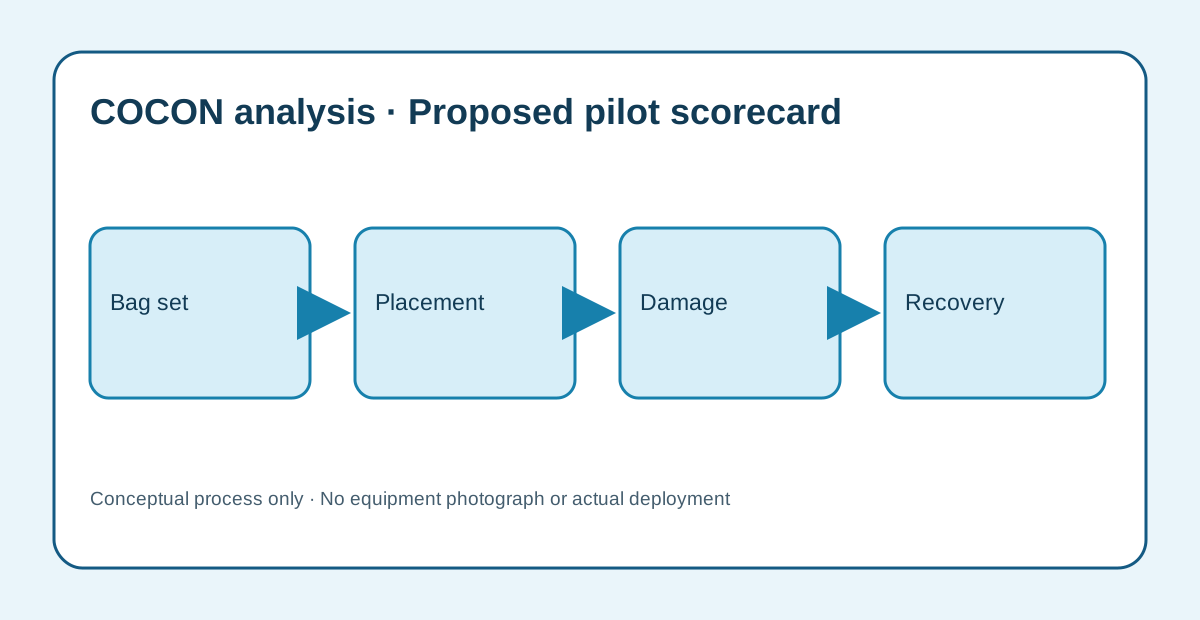
Start by operating the same defined workflow manually. Capture bag mix, time from presentation to confirmed placement, damage or condition observations, intervention events, rework and final usable volume. The proposal is to compare the robot-assisted process against that baseline under equivalent bag categories, rather than announce an arbitrary target percentage. The site and vendor must agree thresholds for correct identification, valid placement, damage, recovery and operator workload before the trial. A stop condition should cover injury risk, unsafe movement, repeated unverified placements or damage above the agreed tolerance. Approval to continue requires the full chain to pass, not just high pick success.
Baseline and acceptance: count decisions, not only cycles
A useful scorecard has denominators. Report the number of bags presented, accepted for automation, diverted, grasped, placed, confirmed and manually recovered. For each stage, record why an item left the automated path. A cycle-time figure should identify whether it includes sensing, planning, container change and human intervention. A packing-density result should state the bag set and container geometry. Damage review should use the same documented condition rules in both manual and assisted runs. Otherwise two numbers that look comparable may answer different questions.
The acceptance meeting should inspect a trace for every failed case, a summary by bag category, and the complete distribution of cycle times rather than one best run. The team should ask whether the system can hold a safe state when upstream data are missing and whether an operator can resume without corrupting the load record. Reaching a target on a curated set is insufficient if an unexpected bag creates an uncontrolled action. These are proposed pilot criteria; no public NEDO notice supplies universal thresholds for an airport. The participating operator must set those thresholds against its own risk and turnaround requirements.
Risks and limitations: variability defeats tidy demos
Baggage differs in shape, stiffness, surface texture, handles, straps, weight distribution and fragility. Even accurate dimensions cannot reveal every contact hazard or internal condition. The same bag may deform under a gripper or change orientation while being transferred. A placement that appears stable in a simulation may shift when the next bag arrives. The mock area may understate vibration, space restrictions, staff movements and schedule pressure. Equipment protection, passenger property and ground-handling safety create obligations that an R&D challenge does not settle.
Another risk is interface ownership. If identification yields an uncertain dimension, who decides whether the planner may continue? If the planner selects an unreachable location, who records the rejection? If a bag is diverted, who updates the load list? A vendor can meet a component metric while the whole workflow remains unusable. COCON would document those responsibilities and test failure injection, including stale IDs and lost network messages. The proposed trial should not be represented as NEDO endorsement, COCON deployment experience or evidence of airport readiness. Its value is to reveal the constraints before a larger commitment.
Buyer checklist: questions for an airport or integrator
Ask what exact bag set and container geometry the evidence covers. Request a confusion matrix for identification categories and a record of uncertain cases. Ask the planner to show how it rejects unstable or unreachable placements, not just how it fills space. Inspect the gripper’s contact points and rules for fragile, soft or strap-bearing bags. Confirm that a placement is observed after release and reconciled to the load record. Require a named person and written method for clearing jams, removing a rejected bag and restarting the sequence.
Then ask who owns site risk assessment, guard design, data retention, maintenance, calibration and changes to the bag population. Specify a baseline collected under the same conditions as the proposed trial. Agree the stop conditions before testing begins, and examine the unsuccessful attempts alongside the successful ones. Ask how the three modules can be replaced or retested without losing traceability. This checklist is COCON analysis to structure a buyer conversation. It should be adapted to the airport’s own rules and reviewed by its responsible safety and operations teams.
COCON view and sources: keep the claim narrow
The useful signal in NEDO’s challenge is its decomposition of a hard physical workflow into identification, planning and manipulation, with later matching intended between streams. That supports a test strategy; it does not prove a finished product. COCON would begin with workflow and site assessment, define the test-bag population, specify system interfaces, coordinate a bounded demonstration, train operators on exception handling and prepare a support plan if the evidence justifies a next stage. These are proposed services and decisions, not a claim of an existing airport customer or official relationship with NEDO.
Methodology: this article was checked on 23 October 2026 against NEDO’s 2 April program notice, 7 July algorithm notice and 9 July screening notice. Dates and contest status come from those primary documents. All system architecture, baseline design, acceptance tests and buyer questions are labeled COCON analysis or pilot proposals. We did not reuse NEDO artwork. The diagrams are original conceptual COCON graphics and depict neither a product nor an actual airport installation. Readers should check later results.
Evidence: NEDO Challenge, Baggage-Loading Robot call · New call for baggage-loading algorithm contest · Screening results for baggage identification and loading robots
Maturity
NEDO research challenge; component screening and scheduled evaluations are not airport production evidence.
Limitations
- Bag variability and deformation can defeat component tests.
- A mock container cannot establish airside safety or turnaround suitability.
- No independent production performance is established by the cited notices.
Questions
Does NEDO’s challenge mean a loading robot is available?
No. The cited documents describe contests and screening, with later assessment scheduled. Availability and operational acceptance need separate evidence.
What is the first measurement to request?
Request the full flow count, from every bag presented through diversion, verified placement and human recovery, using a comparable manual baseline.
Primary sources
- NEDO Challenge, Baggage-Loading Robot callNEDO · 2026-04-02
- New call for baggage-loading algorithm contestNEDO · 2026-07-07
- Screening results for baggage identification and loading robotsNEDO · 2026-07-09
COCON used AI assistance for research, drafting and translation. Cited primary facts were checked on 23 October 2026; operational analysis and the proposed pilot are editorial judgments.
COCON analysis. Pilot suggestions are proposals, not claims of completed customer projects, partnerships, availability, or guaranteed results.
Related COCON resources
Discuss this workflow
Discuss a bounded workflow assessment with COCON; operational and safety owners must approve any airport pilot.
COCON Robotics ↗