News signal
Indonesia Manufacturing Center reported in May 2026 on a forum about accelerating robotics adoption. The forum itself took place in October 2025. Its account highlights initial investment, proof of economic value, integrator capacity, and workforce preparation as implementation issues. That is a policy and ecosystem signal, not a report that any specific warehouse route has been automated. A buyer should read the publication date and event date separately; neither establishes a deployment outcome at the reader's site.
Robot Phoenix currently describes its Camel-600-SP1 as an autonomous mobile robot for material movement and publishes a rated 600 kg payload, a 60 mm lifting stroke, and Laser SLAM or QR navigation alternatives. These are manufacturer specifications, not COCON test results. The two primary sources speak to different layers: one describes Indonesia's adoption discussion; the other describes a candidate device. COCON's question is what would make a single line-replenishment route acceptable in a particular factory. No national adoption statistic or model specification can answer that without site measurements.
Evidence: FGD Strategi Akselerasi Adopsi Robotika: IMC Dorong Kemandirian Permesinan Nasional · Camel-600-SP1
COCON operational interpretation
COCON analysis: line replenishment is a handoff problem before it is a navigation problem. A robot could traverse a corridor correctly and still leave the wrong carrier at the wrong station, arrive after the line's need time, or block a forklift crossing while waiting for a pickup. The operating decision therefore starts with a route, a carrier, a material identity, a receiving rule, and an exception owner. A request for “an AMR” is too broad to make those decisions visible.
The Indonesia commercial scope is material transport and palletizing, with cleaning evaluated separately. For this article the candidate is Robot Phoenix Camel for a carrier-based replenishment task. Yak pallet-handling equipment would require a distinct pallet geometry and handoff assessment; Pudu MT1 and CC1 belong only to facility cleaning and are not transport alternatives. This is COCON's proposed evaluation boundary, not a statement that any model has been installed, stocked, or approved for a named customer. COCON could assess the workflow and site, help select a robot, define a pilot and acceptance criteria, plan interfaces and deployment, train operators, and plan support. Each service remains a proposal until contracted and performed.
The replenishment workflow
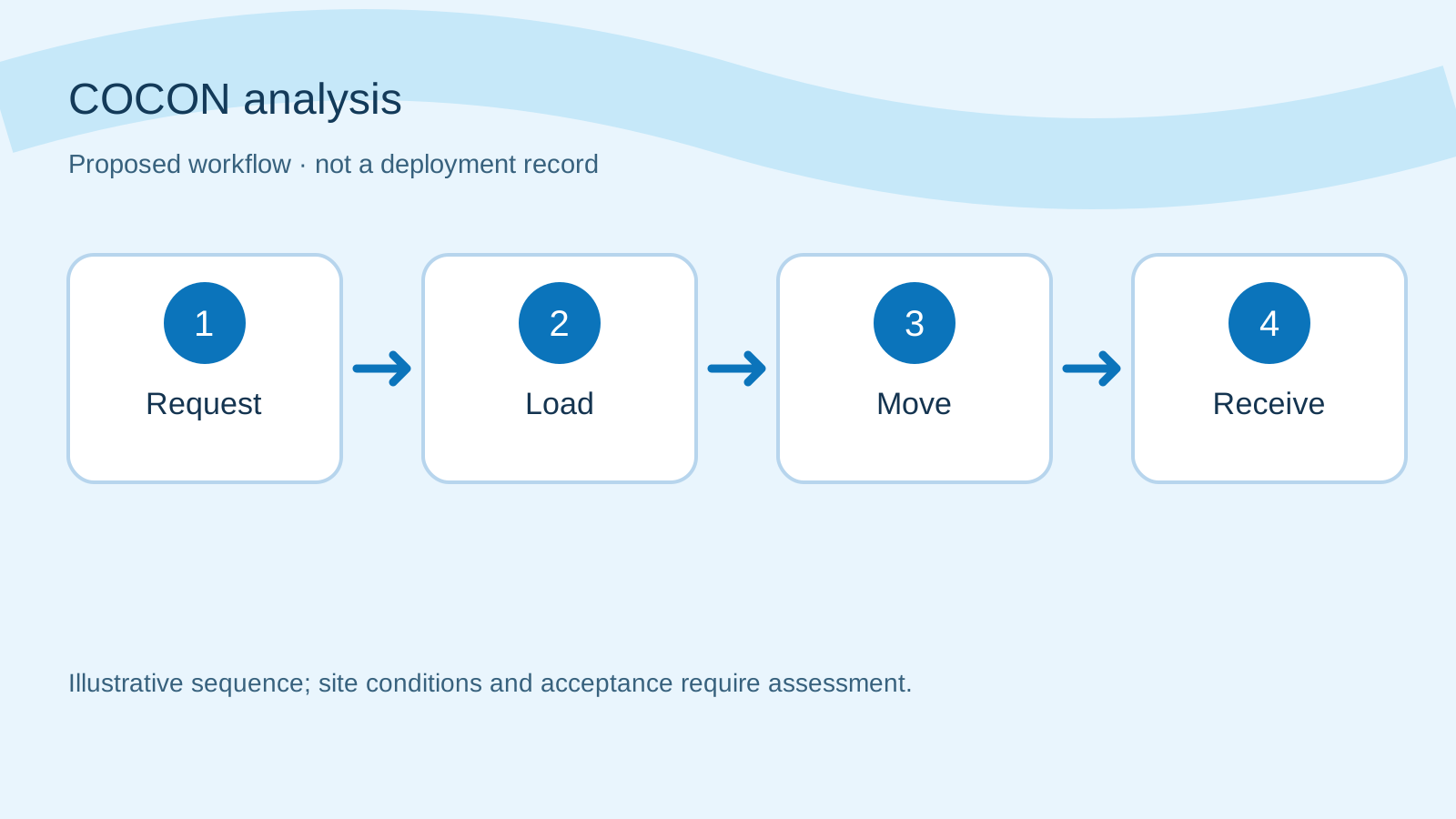
Define the candidate workflow from a supermarket or kitting point to one production station and back. A human or production system releases a replenishment request with a part number, quantity, carrier ID, destination, and needed-by time. At pickup, a responsible person confirms the loaded carrier and its stability. At delivery, a receiving person or controlled station confirms the correct carrier, accepts the material, and records any shortage or damage. The empty carrier then follows a defined return path. These are proposed process steps, not published capabilities of the Camel unit.
Draw the physical route at the times it would actually operate. Include doors, ramps, uneven joints, pedestrians, manual carts, forklifts, parked loads, charging access, and the space needed to turn with a loaded carrier. Mark where traffic may wait without blocking a line or emergency access. Then map the information route: who creates work, how a duplicate request is detected, what state means accepted, and who can cancel or retry. The pilot must have a manual fallback that preserves line supply when the robot stops. Without the material and information handoffs, a successful robot lap says little about useful replenishment.
What is ready and what is unproven
The IMC report demonstrates that Indonesia's industrial community is discussing adoption barriers. It is not a certification of a particular mobile robot, a financing commitment, or evidence that one factory configuration is production-ready. Robot Phoenix's page documents a model and manufacturer-rated parameters. It does not establish that those parameters hold with the reader's load, carrier, floor, congestion, charging pattern, or shift schedule. A manufacturer claim may be a useful screening input; it is not an acceptance result.
COCON would classify the proposed route as unvalidated until the site provides route measurements and the equipment is tested in the intended environment. Readiness has several independent dimensions. Device readiness concerns loading, docking, turning, stopping, and recovery. Process readiness concerns request identity, pickup discipline, receiving confirmation, and manual fallback. Organizational readiness concerns named owners for safety, production, maintenance, IT, and purchasing. Commercial readiness concerns agreed responsibilities, support response, consumables, and changes to layout. One dimension cannot stand in for the others. Passing a short demonstration also cannot establish performance across shifts or seasonal changes.
Evidence: FGD Strategi Akselerasi Adopsi Robotika: IMC Dorong Kemandirian Permesinan Nasional · Camel-600-SP1
Design the whole system
A line-replenishment design needs a load interface before a robot interface. Record the maximum and typical loaded mass, center of gravity, carrier underside, lift engagement points, restraint method, and variations in packing. Check those against a specific candidate configuration and safety review. The Camel-600-SP1 page gives rated load and lift travel, but it does not certify an arbitrary carrier. COCON would request a fit check using the real load and a stop test at the worst permitted route point. Other Camel sizes should be considered only after the task definition, never because a larger rating looks safer on a brochure.
The control design should give each request a unique ID and track it through requested, accepted, loaded, moving, arrived, received, returned, and exception states. Decide whether the first pilot uses a supervised operator entry or an interface to an existing warehouse or production system. Avoid adding a software integration solely to make a pilot look advanced. Safety decisions require a site risk assessment, defined crossing priority, a protected recovery procedure, and confirmation that emergency access remains open. Charging, network behavior, local logs, and support contacts belong in the design review, even if the initial route is short.
Evidence: Camel-600-SP1
One bounded pilot
COCON pilot proposal: choose one supermarket-to-line route, one carrier family, one material class, and one shift pattern. Keep the current manual delivery available throughout the trial. Begin with a supervised dry run using an empty carrier, progress to representative loads after the safety review, and only then accept production requests. Fix the route boundary and the people who may enter it. Any route extension, new carrier, different load type, or automatic dispatch changes the scope and needs a separate review.
The pilot plan should state who can stop the robot, what happens to a request after a stop, and who authorizes restart. Observe ordinary periods and the busiest relevant handoff period rather than choosing only an empty corridor. Record a route map, actual load samples, crossing observations, floor defects, station clearances, and the proposed charge window before selecting a candidate model. COCON's role would be assessment, selection support, pilot design, integration planning, deployment coordination, operator training, and support planning. This is a proposed scope, not a claim that a COCON deployment or local inventory already exists.
Baseline and acceptance
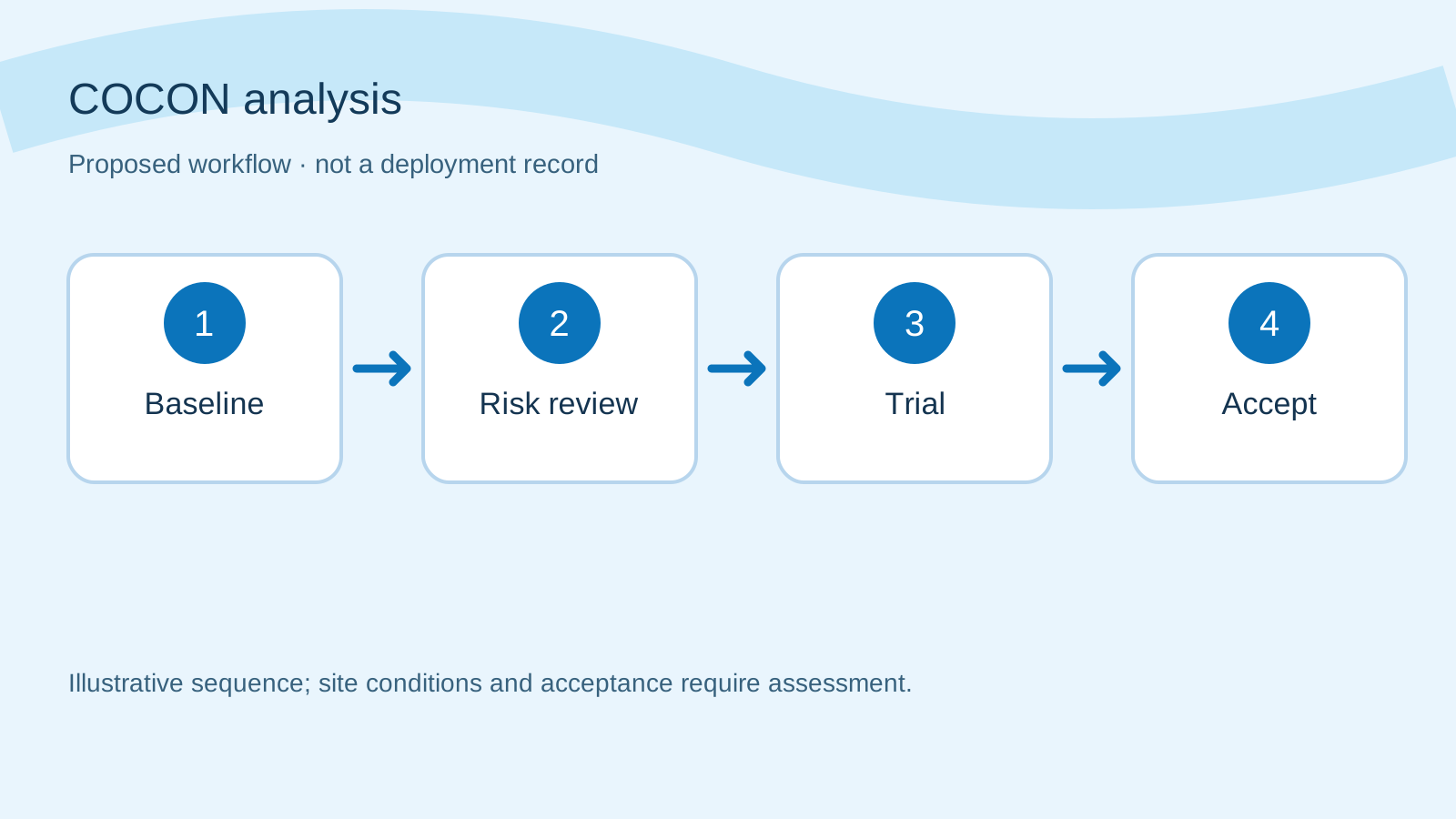
Before testing equipment, observe the present process for the same route and shift. For every request record release time, material and carrier identity, pickup time, arrival time, receipt confirmation, manual intervention, and any line wait attributable to replenishment. Record why a trip was delayed: no carrier, blocked aisle, loading error, wrong destination, shift handover, or an unrelated production hold. Keep exceptional days visible rather than deleting them to improve an average. This is a proposed baseline method, not a reported factory dataset.
The owner and COCON would agree numeric thresholds only after seeing that baseline and completing risk review. Proposed acceptance categories are correct material and carrier at receipt; traceable request-to-receipt history; completion within the agreed need window; no unsafe crossing or blocked emergency access; controlled response to obstacles and lost communications; and a trained manual recovery that avoids duplicate delivery. Count both completed and failed requests. Separate robot faults from process faults, and retain the full denominator. Stop the pilot for unsafe movement, unstable load, unowned recovery, or an untraceable request. A rated speed or endurance value cannot replace these whole-route measures.
Risks and limitations
The main uncertainty is not whether a mobile platform can move. It is whether loaded docking, mixed traffic, shift handover, and exception recovery are repeatable on this particular route. Floor transitions may affect a low platform; packing variation may change the center of gravity; a station may have insufficient clearance for a safe handoff. A busy crossing can create queueing even when every navigation maneuver succeeds. Changes to a door, line layout, or charging policy can invalidate an earlier route test.
Manufacturer specifications are configuration-specific and may be revised. Confirm the current datasheet, actual equipment configuration, permitted loads, local safety obligations, service terms, and replacement-part arrangements before an order. The IMC report discusses adoption obstacles, but does not underwrite a particular business case. Do not infer savings or payback from a rated capacity. An honest cost study includes carrier changes, integration, site preparation, charging, staff time, maintenance, and a manual fallback. If a site cannot identify the process owner, baseline, or safe recovery, the right next step is assessment rather than a hardware promise.
Buyer checklist
Ask the operations owner which single material family causes an observable replenishment problem and how late supply is recorded today. Ask engineering for the actual carrier drawing, representative loaded mass, and difficult floor and crossing points. Ask production who confirms pickup and receipt, including at shift change. Ask safety who can stop movement, isolate the area, and authorize restart. Ask IT what system creates requests and whether a supervised manual interface is enough for the first trial. Ask maintenance who diagnoses faults and what support window the site needs. Ask procurement which costs and responsibilities must be in the pilot agreement.
Use those answers to write an acceptance sheet before requesting a quotation. It should specify route boundaries, load envelope, demand pattern, observation period, baseline method, success categories, stop conditions, data owner, and manual fallback. Have the same people review the sheet after the pilot; changing definitions after results arrive undermines the comparison. For a first discussion with COCON, send one route, one load, one shift pattern, and one measurable pilot objective through the Indonesia pilot page. The invitation is to scope a proposal, not to claim a delivered outcome.
Sources and methodology
Methodology: COCON reopened the two linked primary pages on 21 October 2026. The IMC article was published on 5 May 2026 and describes a forum held on 30 October 2025; those dates must not be collapsed. The Robot Phoenix product page does not show a dated publication notice, so its publication date is recorded as unknown and its specifications are treated as current manufacturer claims at retrieval. COCON did not use search snippets or third-party summaries as evidence. The manufacturer's image catalog was checked for model identity, but no public commercial reuse permission for its individual product photographs was established. The diagrams accompanying this article are original COCON workflow analysis, not product photos or records of a deployment.
This article uses AI assistance for research organization, drafting, translation, and diagram code. Factual statements were checked against the cited pages for this editorial draft. A site-specific pilot still requires an owner, a safety review, equipment confirmation, and written acceptance criteria. The article makes no claim of customer results, local stock, official distribution, or guaranteed performance.
Evidence: FGD Strategi Akselerasi Adopsi Robotika: IMC Dorong Kemandirian Permesinan Nasional · Camel-600-SP1
Maturity
Manufacturer-listed candidate equipment; the proposed Indonesia site workflow has not been validated.
Limitations
- Specifications are manufacturer-reported and depend on equipment configuration and site conditions.
- No customer result, stock, support level, or local performance is evidenced by these sources.
Questions
Can a rated payload approve a carrier?
No. Check real mass, center of gravity, lift interface, floor and stopping behavior with the intended equipment.
What should a first pilot measure?
The full request-to-receipt path, exceptions, line wait and safe manual recovery, against the same-route baseline.
Primary sources
- FGD Strategi Akselerasi Adopsi Robotika: IMC Dorong Kemandirian Permesinan NasionalIndonesia Manufacturing Center / Ministry of Industry · 2026-05-05
- Camel-600-SP1Robot Phoenix · unknown
COCON used AI assistance to organize research, draft, translate, and create original workflow diagrams; cited facts were rechecked against the primary pages on 21 October 2026.
COCON analysis. Pilot suggestions are proposals, not claims of completed customer projects, partnerships, availability, or guaranteed results.
Related COCON resources
Discuss this workflow
Discuss one route, load, shift pattern, and measurable pilot objective via /id/pilot/.
Discuss a pilot ↗