News signal: a Customer Zero test inside Hitachi factories
FANUC’s release describes a strategic partnership with Hitachi to validate and commercialize physical AI by combining Hitachi’s AI technologies with FANUC industrial robots and AI technologies. Hitachi manufacturing facilities in the Ibaraki region are planned as the first Customer Zero environment. The partners identify two concrete factory tasks: picking parts with varied shapes and performing changeovers when the production item changes. They also name recognition accuracy, robot motion, takt time, and quality effectiveness as evaluation areas, giving factory teams a more useful signal than a general promise of autonomy.
The same release says the partners plan to assess Hitachi edge-AI semiconductors with FANUC robots and intend to begin customer deployment in fiscal 2027. Those statements define direction and timing, not completed evidence. The announcement contains no public pilot results, price, supported workpiece range, or acceptance thresholds. Procurement teams should therefore classify this as an announced real-factory validation program. It is more mature than a laboratory concept, yet it remains earlier than a repeatable production offer with independently reviewable performance data.
Why it matters: factory learning must become decision evidence
Physical AI is attractive because conventional automation becomes expensive when part presentation, appearance, or sequence changes. A model that perceives variation and selects an action could reduce some reprogramming around mixed production. The harder problem is operational accountability. A cell may complete most picks while creating irregular micro-stops, hidden manual correction, or quality escapes. An average success rate can conceal those costs. Customer Zero matters only if the factory captures which conditions fail, how operators recover, and whether fixes remain stable after a new item or shift enters the process.
COCON’s view is that the Ibaraki model should be read as a learning architecture, not a shortcut to autonomous production. Production engineers need a frozen comparison process, a structured exception vocabulary, and authority to stop or roll back each model release. The valuable output is not merely a trained model; it is a traceable operating method connecting observations, labels, model versions, robot programs, safety controls, and quality disposition. That method determines whether knowledge from one cell can be transferred responsibly to another line without transferring undocumented risk.
Workflow affected: mixed-part kitting before automatic changeover
A sensible first boundary is mixed-part kitting, not the entire production-model changeover. Inputs are an approved order, identified parts, container presentation, current recipe, and cell readiness. The robot must locate the requested item, choose a valid grasp, move within the permitted envelope, confirm placement, and return a disposition code. Outputs are a complete kit, an exception queue, and a trace linking every attempt to image conditions, part identity, model version, robot state, and operator action. Quality owns the disposition rule; production owns takt and staffing; engineering owns release configuration.
Changeover should follow only after the team understands the picking exceptions. A changeover can affect tooling, fixtures, recipes, inspection logic, and downstream readiness, so a wrong decision carries a wider consequence than a rejected pick. During the first pilot, the AI may recommend a recipe or identify required setup while an authorized person confirms the action. This keeps the experiment focused on perception and handling while producing data about changeover decisions. It also prevents an immature model from silently changing multiple production conditions at once.
System design: keep learning separate from uncontrolled change
The pilot architecture needs more than a robot and an AI model. It needs controlled sensing, lighting, gripper state, part presentation, robot motion limits, a cell controller, order and recipe interfaces, quality confirmation, event logging, and an operator station. Every inference used for motion should be associated with a model version and input record. If an edge device is tested, the team should measure end-to-end decision latency, thermal or compute constraints, failover behavior, and how software is signed and restored. The announcement names edge-AI validation but does not specify an implementation, so these are design questions rather than product claims.
Learning should occur through a governed path. Production data can be collected continuously, but a newly trained model should not update the live cell automatically. Engineers should curate exceptions, remove unusable records, label the correct outcome, test the candidate model offline, and run it in shadow or supervised mode before release. Safety-rated functions remain independent of the learning system. Loss of confidence, sensor disagreement, invalid recipe state, or communications failure should lead to a defined safe state and an intelligible operator message, not an improvised model response.
Pilot plan: one cell, eight weeks, controlled variety
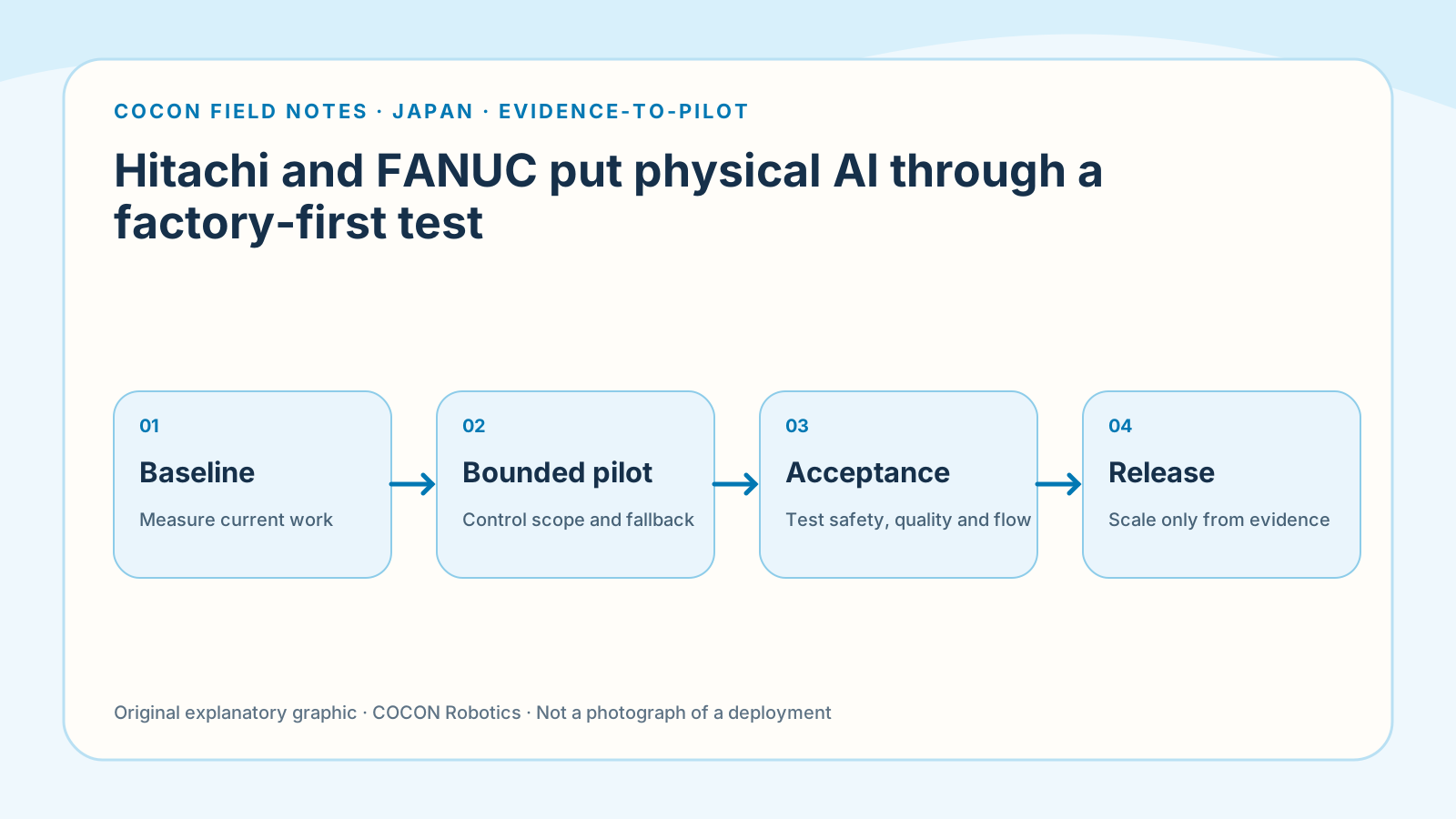
Use one mixed-part kitting cell for an eight-week pilot and keep the fixed-program method available as the comparison and fallback. Before enabling AI-guided picks, record at least representative operating periods across the relevant parts, containers, lighting conditions, shifts, and normal stoppages. Freeze the pilot part family and document exclusions. Weeks one and two establish the baseline and logging; weeks three and four run supervised AI recommendations; weeks five and six permit bounded robot execution; weeks seven and eight test repeatability and a limited set of approved disturbances.
A daily review should separate perception errors, grasp planning errors, motion or collision-avoidance stops, part-presentation problems, interface faults, quality rejects, and operator-requested stops. Each exception needs an owner and disposition. Stop the experiment after a safety-control failure, an uncontained quality risk, loss of traceability, or repeated unexplained motion. Do not widen the part range merely to keep the cell busy. Expansion to changeover assistance should require stable performance on the original mix and a successful rollback rehearsal.
Acceptance: compare distributions, not a single success percentage
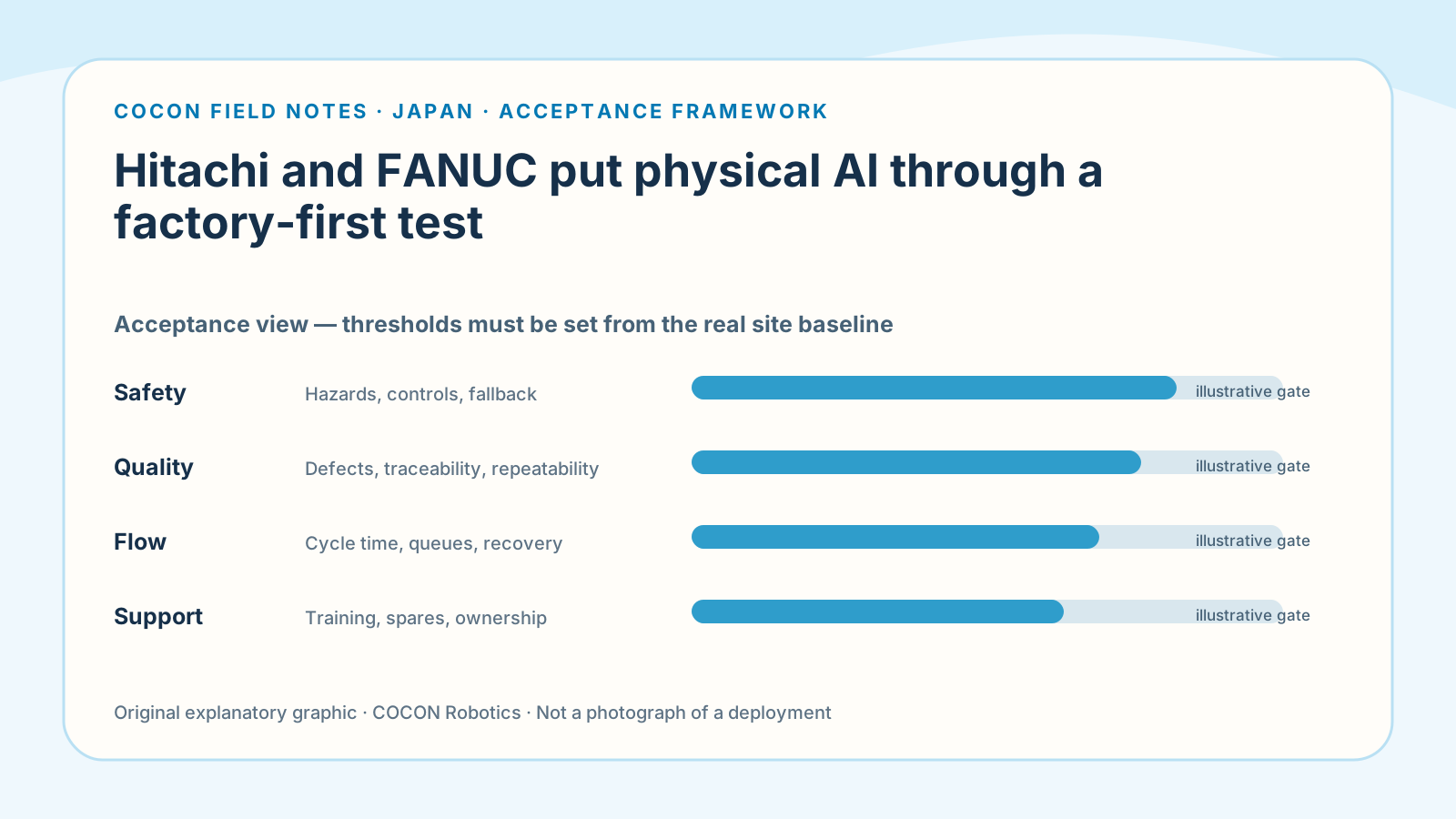
Acceptance begins with definitions. Recognition success should mean the correct part and usable pose were identified under an approved confidence rule. Intervention rate should count every human action required to complete, reset, or correct a cycle. Takt performance should be viewed as a distribution by part and condition, not only an average. Quality must distinguish recovered errors from escaped defects. Recovery time should begin when the cell leaves normal operation and end only when a verified production state resumes. These definitions prevent a pilot from improving one headline number by shifting work to operators.
Thresholds must come from the site’s baseline, risk assessment, and production requirement; the FANUC announcement does not supply them. A release gate could require no safety-control failures, complete event traceability, quality results no worse than the approved baseline, bounded intervention demand, and takt variation compatible with downstream flow. The team should also challenge the model with approved hard cases and confirm that low-confidence inputs reach fallback. A passing average with one severe, unexplained failure is not equivalent to stable production readiness.
Risks and limits: the announcement leaves crucial envelopes open
The public release does not disclose pilot outcomes, pricing, the supported workpiece envelope, gripper assumptions, allowable environmental variation, or service responsibilities. It also does not show whether learning will occur per cell, per factory, or across installations. These gaps are normal at an announced validation stage, but they matter to buyers. A demonstration with curated parts cannot establish performance for reflective surfaces, deformable items, occlusion, contamination, damaged containers, or an unfamiliar product introduction unless those conditions are deliberately tested.
Continuous learning introduces operational and governance risk. Data drift can come from suppliers, lighting maintenance, packaging, camera replacement, tooling wear, or new recipes. A model that improves recognition may still alter motion timing or exception patterns. Cybersecurity, data ownership, retention, remote access, model provenance, and support boundaries therefore belong in the engineering review and contract discussion. Teams should avoid treating the fiscal 2027 deployment target as guaranteed availability in a specific country, cell, or application; it is the partners’ stated plan and remains subject to validation.
Buyer checklist: questions before funding a physical-AI cell
A useful request for information should describe the actual work rather than ask whether a supplier has physical AI. Provide a representative part matrix, presentation conditions, required takt distribution, quality rules, shift pattern, interface map, and current exception history. Ask the supplier to mark what is demonstrated, what needs engineering, and what is excluded. Require the proposed pilot to preserve the current production fallback and state which evidence permits continuation, redesign, or termination. This makes comparison possible even while the Hitachi–FANUC program is still moving toward customer deployment.
Commercial review should separate reusable platform costs from application-specific tooling, data preparation, commissioning, model maintenance, and production support. Clarify who labels exceptions, approves a model version, investigates an incident, and owns derived data. Request a rollback procedure and an exportable record of decisions. If changeover automation is proposed, insist on an independent gate after picking performance is proven. COCON recommends funding a bounded learning experiment first; scale should follow reviewed evidence, not the novelty of the physical-AI label.
- Which exact part shapes, materials, presentations, and environmental conditions are inside the proposed envelope?
- Which recognition, motion, takt, quality, intervention, and recovery measures will be logged and compared with baseline?
- How are model versions approved, deployed, monitored, rolled back, and connected to robot programs?
- Which safety functions remain independent of AI, and what conditions force a safe stop or human handoff?
- Who owns raw data, labels, trained artifacts, event history, and access after the pilot ends?
- What evidence is required before moving from kitting to production-model changeover assistance?
Maturity
Maturity is announced real-factory validation, not proven production deployment. Hitachi and FANUC identify Customer Zero sites, initial workflows, evaluation dimensions, edge-AI exploration, and intended fiscal 2027 customer deployment. As of 4 October 2026, the release gives no completed results, validated workpiece envelope, commercial configuration, or site acceptance evidence.
Limitations
- This analysis relies on one joint vendor announcement and cannot independently confirm performance, reliability, safety outcomes, or commercialization timing.
- The proposed eight-week cell, measures, gates, and stop conditions are COCON recommendations, not commitments or published methods from Hitachi or FANUC.
- No claim is made that COCON represents, distributes, partners with, or has implemented technology for Hitachi or FANUC.
Questions
Does the Hitachi–FANUC announcement mean physical AI is production-ready?
No. It signals validation in Hitachi factories and intended customer deployment from fiscal 2027. The release gives no completed pilot performance, supported workpiece envelope, pricing, or production acceptance results. Buyers still need site evidence against their own takt, quality, safety, and staffing requirements.
Why begin with mixed-part kitting instead of automatic changeovers?
Kitting isolates perception, grasping, placement, and recovery while limiting the consequence of an error. A full changeover can modify tooling, fixtures, recipes, inspection logic, and downstream readiness at once. Proving the narrower loop first makes failures easier to attribute and supports a later changeover gate.
What is the most important physical-AI pilot metric?
No single metric is sufficient. Read recognition with false confidence, human intervention, takt distribution, quality, scrap, recovery time, and trace completeness. The decision view must show where the cell fails and how much human work restores production, not only successful cycles.
Primary sources
- Hitachi and FANUC enter strategic partnership toward joint commercialization of physical AI implementationFANUC Corporation · 2026-09-30
COCON used AI assistance for research, drafting, and translation. The cited announcement and factual claims were checked against the linked primary source on 4 October 2026. Operational analysis and pilot criteria are COCON proposals; no independent product test or human reviewer is represented.
COCON analysis. Pilot suggestions are proposals, not claims of completed customer projects, partnerships, availability, or guaranteed results.
Related COCON resources
Discuss this workflow
Planning a physical-AI factory trial? COCON can help structure a bounded workflow, evidence plan, interface review, and acceptance gate without assuming that an announced capability is production-ready.
COCON Robotics ↗