News signal: an adoption problem and a product claim
Indonesia Manufacturing Center published its account of a robotics adoption forum on 5 May 2026. Its discussion identifies initial investment, credible economic evidence, integrator capacity and workforce development as adoption concerns. That account describes a policy and ecosystem conversation; it is not a measurement of warehouse robot performance. Robot Phoenix separately publishes a Yak FL-1500 autonomous forklift page. The manufacturer lists a maximum load of 1,500 kg, standard fork-tip and pallet-presence detection, Laser SLAM or reflector navigation, and a maximum lifting-height configuration that varies by option. These are manufacturer specifications, not COCON test results or a local stock statement.
Together, the sources support a narrow buyer question: what must be checked before one pallet movement from receiving to storage is assigned to a robotic forklift? They do not prove that any particular warehouse can run the route safely or economically. This article deliberately confines the equipment discussion to Robot Phoenix transport and pallet handling. It does not turn the older research queue's connectivity or multi-vendor recommendation into an Indonesia product offer. The operational advice below is COCON analysis and a proposed pilot, with assumptions to be checked at the actual site.
Evidence: FGD Strategi Akselerasi Adopsi Robotika: IMC Dorong Kemandirian Permesinan Nasional · Yak FL 1500 AMR Forklift Series
COCON analysis: specify the handoff before the machine
The expensive uncertainty in a receiving route often sits at its two ends. Who declares a pallet ready after unloading? Who checks its condition and weight? Who releases the aisle? What confirms the pallet was placed in the correct storage position, at the correct height, without blocking the next task? A robot route can fail while its vehicle navigates accurately, simply because its pickup is inconsistent or its destination identity is ambiguous. COCON analysis therefore starts with a handoff contract, not a catalogue comparison.
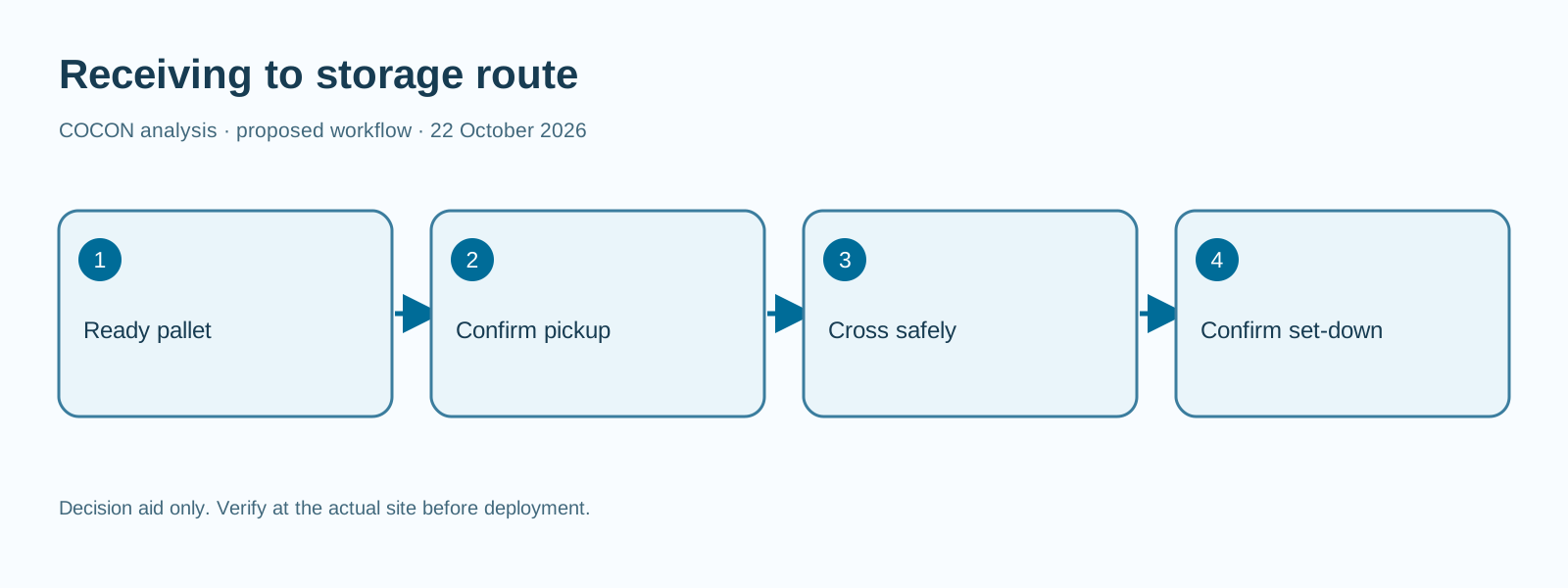
Write the contract in observable terms. A receiving operator identifies the load and makes it available at a marked pickup location. A supervisor or warehouse system authorizes the mission. The vehicle either confirms engagement or rejects the task with a reason. At storage, a location owner confirms the correct lane or bay and closes the movement record. Exceptions return to named people. This is a suggested design, not an existing COCON installation. It can be sketched on a floor plan before any robot is selected and used to compare the present manual route with a proposed automated one.
Affected workflow: one pallet from dock-side staging to storage
Choose one repeatable lane from receiving staging to a specified storage zone. The beginning is a pallet that has already passed inbound identification and quality checks; the end is a confirmed set-down in an assigned position. Keep unloading, put-away allocation and outbound picking outside the first pilot unless their interfaces are essential to this route. This tight boundary makes errors diagnosable. If a pallet is not ready, the robot should not guess. If a storage bay is occupied, the mission needs a safe hold or human reassignment, not a silent placement nearby.
Observe the path with real shift traffic. Record pedestrian crossings, manual forklifts, temporary stock, doors, ramps, wet patches, damaged floor, charging access and any place a vehicle can be trapped. Measure the actual pallet dimensions, fork-entry condition, load centre and variation; a stated rated load alone does not prove compatibility. Identify the owner of each physical change, because a staging mark moved by a few centimetres or a different pallet supplier can invalidate a successful demonstration. The goal is a controlled route with an understandable exception path, not a cinematic driverless tour.
Maturity: catalogue capability still needs site qualification
Robot Phoenix's Yak FL-1500 product page is a first-party specification for a commercial equipment family. It describes pallet handling and lists sensors, navigation and safety features. The page does not publish results for COCON, for the proposed Indonesian route, or for a buyer's pallets and traffic pattern. The IMC source says robotics adoption requires stronger evidence and integration capacity, but it does not certify this vendor or model. Treat product capability as a candidate input and site suitability as an unproven question until the buyer's acceptance test is completed.
There is a detail worth resolving before procurement: the manufacturer overview says lifting height up to 2,500 mm, while the specification table gives 1,600 mm or 2,500 mm as an option. Ask which exact fork, mast and configuration would be quoted, and request drawings for aisle clearance, turning, floor loading and pallet engagement. Do not infer that the optional height, navigation mode or obstacle-detection option is included in a specific offered unit. Also verify current availability and service terms directly; neither source establishes local inventory or COCON's distributor status.
Evidence: Yak FL 1500 AMR Forklift Series · FGD Strategi Akselerasi Adopsi Robotika: IMC Dorong Kemandirian Permesinan Nasional
System design: floor, data, traffic and human ownership
A viable design has four linked layers. The physical layer covers pallet and fork fit, rack or floor position, gradient, slab condition, clearance and charging. The control layer specifies where missions come from, how a pickup is authorized, and when a location is considered occupied. The traffic layer governs crossings, manual forklifts, pedestrian zones, blocked aisles and emergency stops. The human layer assigns operators to rejected tasks, recovery, maintenance and shift handover. Testing only the vehicle's navigation leaves the other three layers undocumented.
For the first pilot, a supervised dispatch interface may be simpler than a deep warehouse-management integration. If a WMS connection is planned, define the task identifier, source, destination, completion acknowledgement and duplicate-message behavior on paper before software work begins. Loss of network or a conflicting task must leave the load and vehicle in a known safe state. These are proposed integration questions; no system compatibility is asserted. COCON can propose workflow and site assessment, robot selection, pilot scope, integration planning, deployment coordination, operator training and support planning. The scope is prospective and must be agreed with the buyer.
One bounded pilot: one route and one shift pattern
COCON pilot proposal: run a supervised receiving-to-storage route for one defined pallet family, one pickup position, one destination zone and one agreed shift pattern. Confirm the site's safety review and operator procedures before motion testing. Start with empty and representative loaded pallets, then increase task frequency only while exception handling remains controlled. Keep a manual fallback route available. Freeze the equipment configuration, floor markings and pallet specification during the comparison period; log any changes instead of treating the run as continuous evidence.
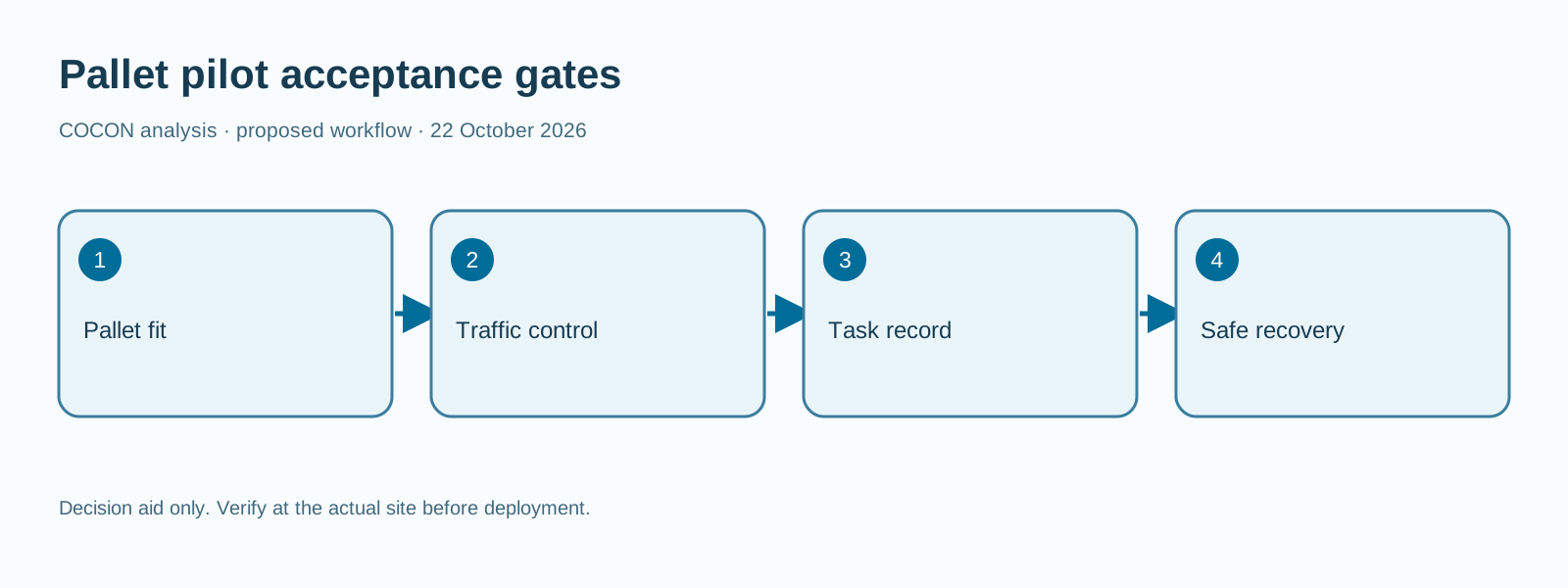
Include ordinary but difficult cases: a pickup position out of tolerance, a blocked storage position, an unexpected pedestrian approach, a manual forklift crossing, a temporary aisle obstruction and a mission cancellation after the pallet has been engaged. Do not deliberately create unsafe encounters. Safety staff design controlled tests. Stop the pilot for a missed pallet engagement, ambiguous set-down, unsafe proximity, unowned exception, repeat obstruction without recovery, or loss of required communications. One successful shift would only justify the next review step. It would not establish an all-shift service level, local support capacity or financial return.
Baseline and acceptance: measure complete pallet movements
Before a robot is introduced, record the present route over representative shifts. Count requested moves, completed moves, waiting time before pickup, travel and set-down time, manual interventions, rework, wrong-location corrections, and periods when the aisle is blocked. Separate loading-dock delays from transport delays so a robot is not credited for work it cannot affect. Record pallet type and weight band, route state, operator staffing and peak traffic. If the current data are poor, the first stage of the pilot is a measurement exercise, not a business-case result.
Set acceptance thresholds with the buyer before testing. The proposed categories are verified pickup and set-down, correct destination, no unsafe interaction, a recoverable response to blocked paths and failed missions, a complete movement record, and an agreed limit on interventions and end-to-end time. Site owners choose actual numeric thresholds after considering the baseline and risk assessment. Report the full distribution, not only a mean. An occasional long recovery can matter more than a small improvement in average travel. Acceptance should require a written decision by operations and safety, with unresolved items assigned to owners and dates.
Risks and limitations: pallet variability and mixed traffic
Pallet variability is a primary risk. Broken boards, skewed loads, wrap tails and inconsistent fork pockets change the engagement problem. A forklift with a rated load still needs a compatible load centre, fork geometry and safe route. The catalogue page describes obstacle detection, but it does not show how this particular site will handle blind corners, workers stepping out, or a manual truck stopping across the path. A local risk assessment and supervised tests are required. Floor damage, reflective surfaces, outdoor transitions or altered storage layouts can change the navigation problem after commissioning.
Economics are uncertain until the baseline captures labor, rework, delays, energy, maintenance, space and supervision. A robot may move the pallet while leaving the most time-consuming receiving checks untouched. The IMC discussion signals that adoption needs credible economic evidence; it does not provide a universal ROI. COCON does not claim a customer result, available stock, exclusive relationship, installation history or guaranteed support level. Any future proposal should state the exact equipment configuration, supplier responsibilities and local service plan before the buyer makes a commitment.
Evidence: FGD Strategi Akselerasi Adopsi Robotika: IMC Dorong Kemandirian Permesinan Nasional · Yak FL 1500 AMR Forklift Series
Buyer checklist for a first robot-forklift discussion
Ask for the pallet drawing, load range and acceptable damage condition. Ask which Yak FL-1500 configuration is actually proposed, including lift-height option, navigation mode, fork dimensions and sensor options. Ask who authorizes the move, who owns the pickup and destination positions, and what system closes the task. Ask how the route handles occupied bays, crossing traffic and manual override. Ask for a floor and aisle survey, charging location, maintenance access, operator training plan and recovery procedure. Ask how every failed mission will be logged and reviewed during the pilot.
Request a route map showing not only the shortest path but the human crossings and waiting points. Keep a decision log: what is confirmed by a manufacturer document, what is observed on the floor, and what remains a proposal. Procurement should seek written evidence for parts, service, training and support terms, rather than inferring them from a product page. The result of a good first conversation is a testable scope with clear exclusions. It is not a promise that a robotic forklift is the best choice for every pallet movement.
Sources, methodology and the next site question
Method: COCON reopened the IMC account published 5 May 2026 and Robot Phoenix's Yak FL-1500 product page on 22 October 2026. The product page does not display a publication date, so its date is recorded as unknown. The two independent primary publishers support the limited statements attributed to each: adoption concerns from IMC and manufacturer specifications from Robot Phoenix. They do not jointly prove performance, availability or a market-wide forecast. The workflow, risk map, metrics and pilot protocol are original COCON analysis and proposals, with no claimed first-hand deployment.
We did not reproduce the manufacturer photograph. Its presence in the existing project catalogue records model provenance, but no individual commercial editorial license was verified for this article. The accompanying diagrams are original COCON decision aids, not photographs of a Yak or a customer site. For a practical next step, bring one receiving-to-storage route, one pallet and load range, one shift pattern and one measurable pilot objective to the Indonesia pilot discussion. The Indonesia AMR and AGV service page and product scope explain the proposed assessment route; the pilot inquiry can turn those facts into a bounded evaluation.
Evidence: FGD Strategi Akselerasi Adopsi Robotika: IMC Dorong Kemandirian Permesinan Nasional · Yak FL 1500 AMR Forklift Series
Maturity
Yak FL-1500 is a manufacturer-listed pallet-handling model; site suitability and local delivery have not been verified.
Limitations
- Manufacturer specifications are configuration-dependent and are not local performance results.
- Floor, pallet, traffic and integration conditions require site assessment.
Questions
Does a 1,500 kg rating qualify every pallet?
No. Confirm actual load, pallet condition, fork geometry and load centre for the quoted configuration.
Where should the first pilot end?
At a confirmed set-down in one assigned storage zone, with a logged exception path for blocked or rejected tasks.
Primary sources
- FGD Strategi Akselerasi Adopsi Robotika: IMC Dorong Kemandirian Permesinan NasionalIndonesia Manufacturing Center / Ministry of Industry · 2026-05-05
- Yak FL 1500 AMR Forklift SeriesRobot Phoenix · unknown
AI assistance supported research, drafting and translation. COCON analysis and pilot proposals are labeled. Primary pages were checked on 22 October 2026; no named human reviewer or first-hand deployment is claimed.
COCON analysis. Pilot suggestions are proposals, not claims of completed customer projects, partnerships, availability, or guaranteed results.
Related COCON resources
Discuss this workflow
Discuss one route, load, shift pattern and measurable objective via /id/pilot/.
Discuss a pilot ↗