News signal: adoption evidence meets a defined AMR category
Indonesia Manufacturing Center published an account of a national robotics adoption discussion on 5 May 2026. The article describes concerns around investment, economic evidence, integrator capacity and workforce development. It does not report a finished-goods AMR pilot or measure what a warehouse can save. Separately, Robot Phoenix lists the Camel-1000-D as a low-profile lifting autonomous mobile robot for moving pallets, racks and large work-in-process loads. Its published specification gives a rated payload of 1,000 kg and a 60 mm lifting height. Those are manufacturer statements to check against a real carrier and site, not proof of local availability or performance.
Together the sources support one narrow commercial question: can an Indonesian factory move a released finished-goods load from a quality buffer to dispatch staging with a controlled handoff? The answer depends on load, route and handoff conditions. This article treats the IMC publication as a policy and ecosystem signal and the Robot Phoenix page as vendor data. The workflow design and pilot below are COCON proposals, not reports of completed customer work.
Evidence: FGD Strategi Akselerasi Adopsi Robotika: IMC Dorong Kemandirian Permesinan Nasional · Camel-1000-D
COCON analysis: finish the ownership chain first
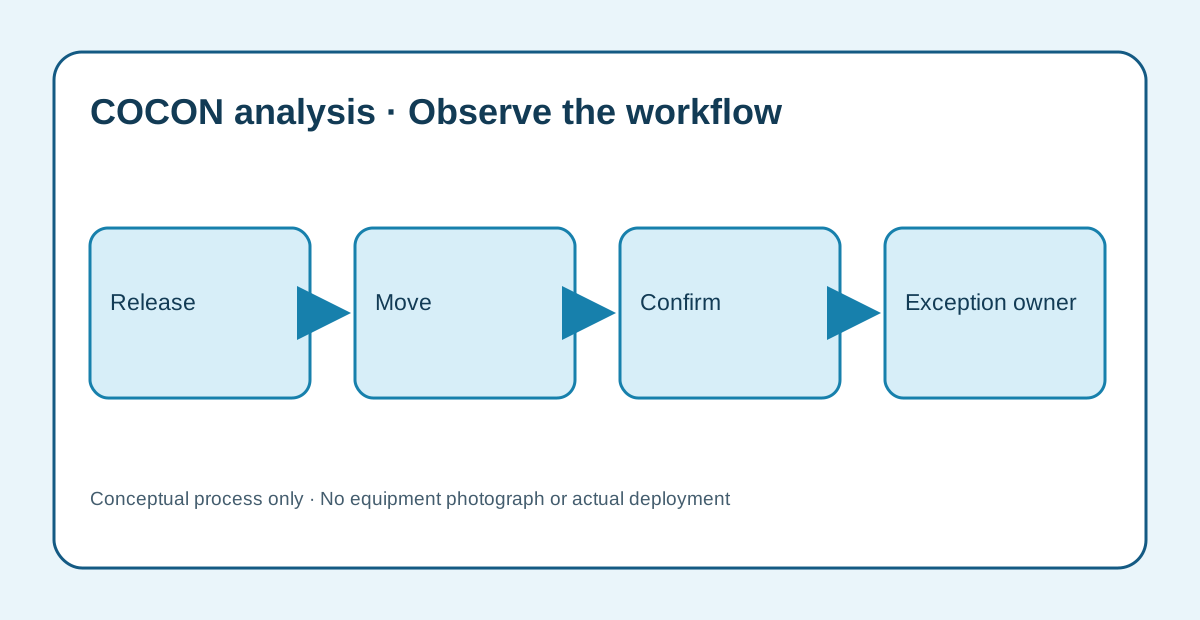
Finished goods often cross an organizational boundary before they cross a building. Quality or production releases a batch, warehouse staff accept it, dispatch assigns a lane, and a vehicle moves the physical unit. An AMR can complete a trip while the wrong load is staged or the dispatch lane is blocked. COCON therefore frames this use case around the release-to-receipt record. The robot mission should start only when a named owner confirms that the load, carrier and destination match. It should end only when the destination confirms the actual unit and the route record closes.
This is COCON operational analysis rather than a claim from either cited source. A first assessment should map where a load is truly ready, what label identifies it, who can change the lane, and how urgent rework loads are diverted. If that handoff is informal today, digitizing the route without fixing ownership may merely move ambiguity faster. The proposed service is workflow and site assessment, equipment selection, pilot scope and acceptance criteria, integration planning, deployment coordination, operator training and support planning. It should be discussed as a proposal, not as an assertion of stock, completed installations or measured savings.
Affected workflow: quality buffer to one dispatch lane
Choose one product family and one carrier type moving from an approved quality buffer to a marked dispatch staging lane. The starting event is a human or system release confirming that finished goods are accepted for movement. The ending event is a physical and digital receipt in the assigned lane. Production, quality inspection, truck loading and shipping-document generation stay outside the first route, except for the signals needed to prevent an incorrect move. A supervisor must own blocked-lane and wrong-label exceptions. This boundary yields a testable question: can the right unit reach the right lane with fewer unaccounted handoffs?
Walk the route across all intended shifts before choosing equipment. Record people, manual forklifts, cross aisles, doors, temporary stock, cleaning periods, surface changes and locations where a load might obstruct egress. Inspect the carrier underside and lift interface rather than assuming a low-profile robot can lift any pallet. The Camel-1000-D page lists only 60 mm of lift, so clearance and load stability must be checked with the actual carrier. If the task requires fork insertion or elevated pallet placement, a Yak forklift suitability assessment is a different workflow; do not force a Camel into it.
Evidence: Camel-1000-D
Maturity: catalogue specification is not site acceptance
Robot Phoenix publishes a Camel-1000-D description and specification table. The page states a 1,000 kg rated payload, low-profile dimensions, Laser SLAM or QR-code navigation and a 60 mm lift. These data describe a product as represented by its maker. They do not establish a local inventory position, a COCON distributorship, a support-level agreement, tested floor compatibility or a throughput result at an Indonesian factory. The IMC account supports the need for considered adoption but contains no validation of this model on the proposed route.
COCON would treat maturity as three separate questions. Is the model and carrier mechanically compatible? Can a controlled route be integrated with the actual release and lane-allocation process? Can the site operate and recover the system through representative shifts? A supervised site pilot supplies evidence only within its declared conditions. Procurement should request configuration-specific support and interface details.
Evidence: Camel-1000-D · FGD Strategi Akselerasi Adopsi Robotika: IMC Dorong Kemandirian Permesinan Nasional
System design: unit identity, carrier and traffic
The proposed system has four layers. The load layer defines weight range, dimensions, centre of gravity, securing method and carrier underside. The route layer defines travel space, crossings, right-of-way rules, charging location and human access. The information layer carries load ID, release state, destination, mission status and receipt confirmation. The ownership layer assigns who authorizes a move, resolves a blocked lane, recovers a stranded load and approves a configuration change. A robot selected without these layers can navigate yet still deliver the wrong unit or stop in a critical aisle.
The Camel-1000-D is a candidate for suitable low-lift carrier transport, not a universal answer. Match its stated payload and lift geometry to the worst approved load, including the carrier. Verify floor slope and transitions, turning clearance, sensor visibility and load overhang at the actual site. Decide whether a simple supervised dispatch list is enough for a pilot or whether an existing warehouse or production system must exchange status. The integration contract should define duplicate missions, lost network messages, label mismatch and manual override. Safety review must account for pedestrians and manual vehicles; claimed navigation accuracy cannot substitute for site risk assessment.
Evidence: Camel-1000-D
One bounded pilot: released loads to a single staging lane
COCON proposes one supervised route from a quality-release buffer to one dispatch lane, using one finished-goods family and one compatible carrier. Limit the first phase to a documented shift window and a measured number of representative movements. Do not include every dispatch lane or change pallet types mid-trial. Mark pickup and set-down positions, verify load labels before release, assign an exception owner, and reserve a safe hold position if the destination is occupied. Operators should practice a manual recovery before the robot carries production goods. This is a proposed pilot, not a deployment history.
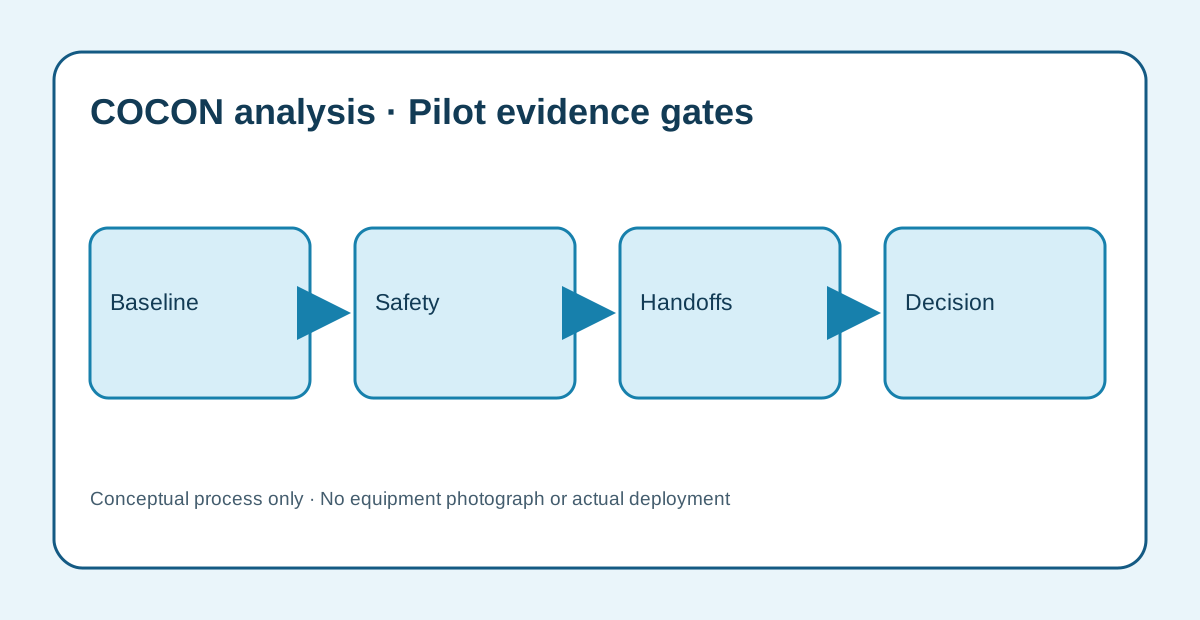
Collect a manual baseline first: total moves, actual travel and wait times, mistaken or missing handoffs, aisle obstructions, manual interventions, and readiness-to-receipt time for the same load family. The pilot records the same measures plus robot mission failures, detours, traffic stops, charging interruptions and assisted recovery. Decide acceptance thresholds before starting; do not select an attractive percentage after seeing the data. A wrong load or uncontrolled crossing is a stop condition. Passing the pilot requires accurate identity, safe route behavior, complete receipt records and operator recovery within the agreed procedure, not merely a completed travel cycle.
Baseline and acceptance: measure the whole transfer
Use a movement ledger with one row per released unit. Record release time, pickup confirmation, mission start, interruptions, lane receipt and final owner. Report the fraction of eligible moves accepted by the robot with the total eligible moves as denominator. Separate travel time from wait time caused by an unavailable lane. Count load mismatches, blocked crossings, manual rescue and resets; do not hide them inside an average cycle. Compare equivalent shift windows, load classes and traffic conditions, and show a distribution rather than the fastest demonstration.
The acceptance review should inspect every exception and ask what action an operator actually took. If a label is missing, the robot must not guess. If a lane becomes occupied after dispatch, the mission should hold safely and alert the assigned owner. If a network link drops, the load record must remain reconcilable. An economic case may later consider labor assignment, carrier changes, infrastructure, integration, training, energy and support, but no return-on-investment figure follows from the source documents. A bounded pilot is a way to generate site evidence and a decision about the next route, not a guarantee of savings.
Risks and limitations: the route can change under the robot
The chief uncertainty is often the site rather than nominal carrying capacity. Packaging can change, carriers can be damaged, a dispatch lane can be reassigned, and peak traffic can fill an aisle that looked empty during a walk-through. A rated payload does not prove safe handling of an unbalanced stack, and the 60 mm lift does not prove carrier fit. Verify both physically.
Organizational risks are equally concrete. Quality may revoke a release after a mission starts. Dispatch may change the lane without updating the robot task. A shift change can leave nobody responsible for a stranded carrier. The pilot needs a written override, an escalation contact and a reconciliation step for every interrupted move. Robot Phoenix specifications are vendor statements; COCON has not independently tested the model for this site. The IMC discussion is not a warehouse performance study. Neither source supports claims about local stock, official distribution, customer results, return on investment or nationwide suitability. These limits should remain visible in a buyer conversation.
Evidence: Camel-1000-D · FGD Strategi Akselerasi Adopsi Robotika: IMC Dorong Kemandirian Permesinan Nasional
Buyer checklist: questions before an AMR Indonesia pilot
Ask for a drawing and sample of the exact carrier with its underside clearance and full-load centre of gravity. Verify the complete load weight against the specified configuration. Ask who releases a finished-goods unit, who can change its destination, and who confirms physical receipt. Walk the route with operations and safety staff during the busiest intended shift. Identify crossings and blocked-lane behavior. Request the model-specific interface, charging, maintenance and support plan before agreeing on a test schedule. Keep the scope to the Robot Phoenix material-transport candidate rather than treating cleaning equipment as a transport substitute.
Ask what constitutes a successful movement when the robot must stop or a person intervenes. Request a baseline covering all eligible loads, not just easy movements. Define handling for missing labels, duplicate missions, revoked quality status, power loss and unreachable staging. Agree who inspects the load after an emergency stop and who updates the movement record. Require training and documented handover. These are COCON questions to resolve through site observation and supplier evidence.
COCON view and methodology: decide on one route
The IMC discussion points to the need for credible adoption evidence and integration capacity. Robot Phoenix provides a specific candidate model for low-profile load transport. Neither document decides whether a particular finished-goods route should be automated. COCON’s proposed role is to assess the route and carrier, select a suitable robot configuration, define a pilot and acceptance criteria, plan interfaces, coordinate deployment, train operators and plan support. Cleaning, palletizing and forklift work remain separate assessments.
Methodology: on 23 October 2026 we reopened the IMC article dated 5 May and the Robot Phoenix Camel-1000-D product page, whose publication date is not stated. Product capacities are attributed to the manufacturer. All workflow controls, measures, acceptance tests and service steps are labeled COCON analysis or pilot proposals. We reused no product photograph because its appearance in a catalogue does not itself prove commercial image rights. The original diagrams show abstract handoffs and evidence gates, not hardware or a COCON deployment. To discuss a pilot, bring one route, load and carrier, shift pattern and measurable objective to the Indonesia pilot page.
Evidence: FGD Strategi Akselerasi Adopsi Robotika: IMC Dorong Kemandirian Permesinan Nasional · Camel-1000-D
Maturity
Manufacturer product listing plus adoption discussion; no site-specific pilot evidence or local stock is established.
Limitations
- Carrier underside and 60 mm lifting geometry require physical matching.
- Mixed traffic, lane reassignment and shift ownership remain site risks.
- Neither cited source supports ROI or COCON customer claims.
Questions
Can a Camel AMR lift any pallet?
No. The maker lists a 60 mm lift for Camel-1000-D. The actual carrier underside, load stability and full weight require a site check.
What should the first pilot decide?
Whether one released load can reach one assigned lane with verified identity, safe traffic behavior and a recoverable exception path.
Primary sources
- FGD Strategi Akselerasi Adopsi Robotika: IMC Dorong Kemandirian Permesinan NasionalIndonesia Manufacturing Center / Ministry of Industry · 2026-05-05
- Camel-1000-DRobot Phoenix · unknown
COCON used AI assistance for research, drafting and translation. Primary facts were checked on 23 October 2026; the workflow and pilot are COCON editorial proposals.
COCON analysis. Pilot suggestions are proposals, not claims of completed customer projects, partnerships, availability, or guaranteed results.
Related COCON resources
Discuss this workflow
Bring one route, load and carrier, shift pattern and measurable objective to /id/pilot/ to discuss a proposed Indonesia pilot.
Discuss a pilot ↗