News signal: BRIN is designing for Indonesia's difficult routes
On 23 January 2026, Indonesia's National Research and Innovation Agency, BRIN, published an overview of CARRIE, short for Collaborative Autonomous Robot for Rugged Industrial Environment. The Smart Mechatronics Research Center describes the system as an autonomous, collaborative material-delivery robot for complex industrial environments. The source makes the problem unusually concrete: uneven surfaces, narrow spaces and dense traffic are not peripheral edge cases; they are among the operating constraints the research intends to address.
BRIN says CARRIE uses an adaptive mechanical platform intended to negotiate uneven surfaces and obstacles. The agency also discusses downstream commercialization as a future direction. That wording matters. It identifies a research and technology-transfer ambition, not a commercial product with publicly documented payload, endurance, certification, field availability or production uptime. A buyer should preserve that distinction in every internal memo and supplier conversation.
- Confirmed developer: BRIN's Smart Mechatronics Research Center
- Confirmed target: autonomous, collaborative material delivery
- Named constraints: uneven surfaces, narrow spaces and dense traffic
- Declared direction: candidate for downstream commercialization, not a published deployment
Evidence: CARRIE, Robot Otonom Pengantar Barang di Industri Kompleks
Why it matters: route difficulty changes the AMR business case
Many AMR evaluations start with rated payload, catalogue speed and battery capacity. Those fields are easy to compare, but they can obscure the constraint that determines whether a delivery is completed: the route. A short floor transition can destabilize a load. A narrow pinch point can turn two-way traffic into a queue. A frequently blocked aisle can make theoretical travel speed irrelevant. Dense human and vehicle traffic can increase cautious stops until a fast robot delivers slowly.
For Indonesian brownfield facilities, COCON's view is that route condition should be treated as production data. Measure floor joints, ramps, thresholds, turning space, doorway clearance, pedestrian peaks, forklift crossings and temporary obstructions. Record when those conditions change between shifts. The purpose is not to prove that a site is difficult; it is to identify which difficulty causes delay, intervention, load instability or unsafe behavior and whether a robot can remove that constraint without moving the problem elsewhere.
- Use route evidence before model selection
- Define the failure caused by each environmental condition
- Separate mechanical traversal from safe, repeatable delivery
- Do not translate a research objective into a guaranteed specification
Evidence: CARRIE, Robot Otonom Pengantar Barang di Industri Kompleks
Workflow affected: one tote, two handoffs and every exception between them
A useful CARRIE pilot begins with a single internal-delivery job, not a fleet. The upstream operator receives a replenishment signal, prepares one standardized tote, verifies its identity and places it at a defined pickup point. The transport task is released only when the tote and route are ready. At the destination, a named downstream owner confirms receipt before the task closes. This boundary exposes whether delays come from movement or from waiting for people, material and information.
The route map should divide the journey into observable segments: pickup alignment, open travel, a floor transition, the narrowest passage, a shared-traffic zone, destination approach and charging return. For each segment, record expected behavior and recovery authority. If a pallet blocks the narrow passage, does the robot wait, reroute or request help? If the tote shifts after a threshold, who is allowed to reposition it? If localization is lost, how does the operator prevent a duplicate task after recovery?
- Input: one identified, standardized tote at a controlled pickup point
- Transport: one mapped loop with named floor and traffic challenges
- Output: acknowledged delivery at a fixed destination
- Fallback: a safe manual method that cannot create duplicate movement
- Owner: one operations lead accountable for end-to-end completion
System design: make the rugged route an engineering specification
The mechanical design question is whether the mobile base, wheels, suspension or other adaptive elements can cross the measured surface changes while keeping the standardized tote stable. The public BRIN source describes an adaptive platform but does not publish limits. A pilot specification should therefore state the actual threshold heights, gaps, slopes and turning envelopes on the selected loop. Test them at the agreed load and operational speed instead of accepting a general claim about obstacle handling.
Navigation and traffic control form a separate design layer. Mark where localization references may change, where people or forklifts enter the path and where stopping would block another process. Define maximum waiting before escalation, allowed rerouting, restart behavior and the human interface for assistance. CARRIE is described as collaborative, but the source page does not publish a safety certification or site risk assessment. Collaboration must therefore be demonstrated through the site's own hazard review and approved operating controls.
- Mechanical boundary: measured floor transitions, load stability and turning space
- Navigation boundary: localization, blockage response and restart state
- Human boundary: crossings, assistance requests and safe fallback
- Energy boundary: charging location, access and interrupted-task behavior
- Data boundary: one event record from task release through acknowledgement
Evidence: CARRIE, Robot Otonom Pengantar Barang di Industri Kompleks
Pilot plan: prove one 80–150 metre delivery loop
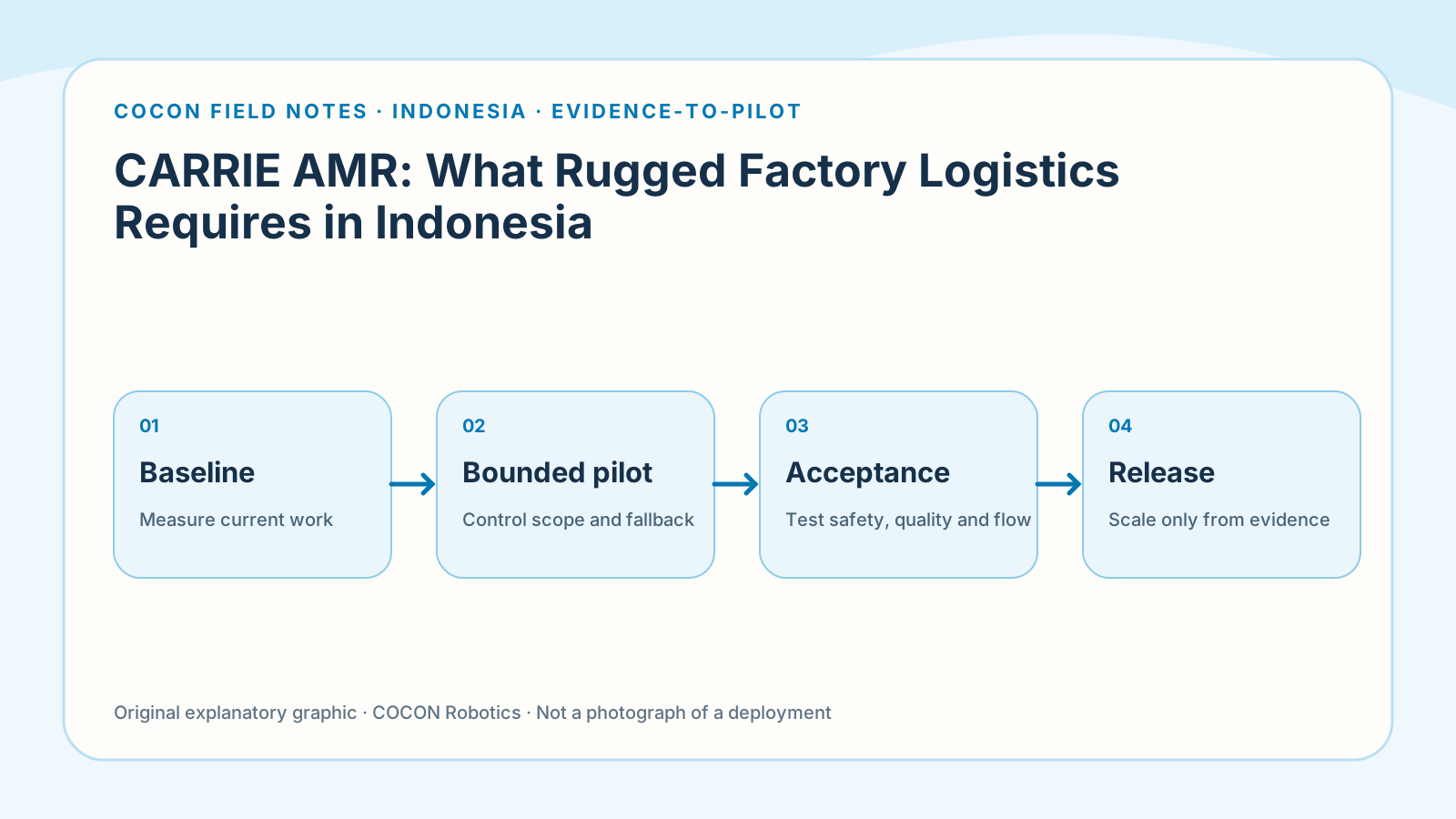
Commission CARRIE in stages. First, inspect the empty route and measure every transition. Second, complete supervised unloaded runs. Third, add the standardized tote and repeat the route at controlled operating conditions. Fourth, introduce the normal traffic window with observers positioned at the pinch points. Only after safe behavior and repeatable recovery are demonstrated should the site attempt the two-shift evaluation. This sequence protects both people and the quality of the evidence.
Stop the pilot after any unsafe motion, unstable load, repeated localization loss at the same point, damage, unapproved route departure or recovery that requires knowledge unavailable to site staff. A stop is not automatically a project failure; it identifies an engineering issue. The team should log the condition, contain the route, agree a correction and repeat the affected test. Scope changes, such as another tote or a different destination, belong in a later phase.
- Scope: one route, one tote, one pickup and one destination
- Baseline: two comparable manual shifts
- Pilot: two shifts after staged commissioning
- Observers: pickup, floor transition, traffic pinch point and destination
- Stop conditions: unsafe motion, load instability, repeated state loss or unowned recovery
Acceptance: measure recovery and load condition, not just arrival
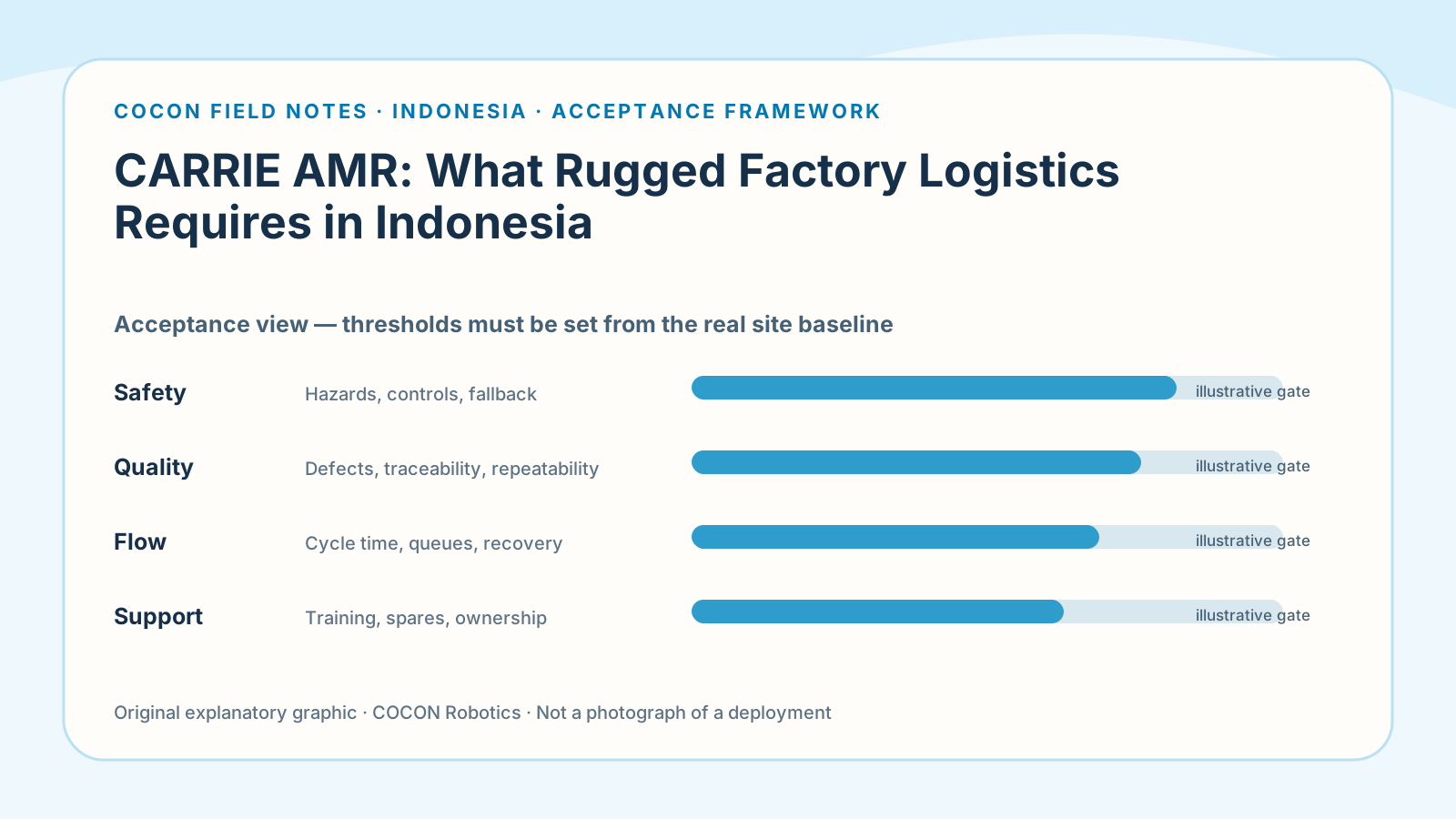
The rugged-route scorecard should include localization-loss events, blocked-path events, successful autonomous recovery, requests for human help, time to resume, load movement and vibration observations, charging interruptions and safe-stop behavior. Where a physical measurement method is not available, define a repeatable inspection rubric before testing. For example, the same tote placement marks and the same observer checklist can make load-shift findings comparable across runs.
Acceptance also requires operational ownership. A trained shift operator should be able to identify the robot's state, place it in a safe condition, call the correct support role and resume or transfer the task without duplicating delivery. Maintenance should be able to perform the agreed daily inspection and record wear related to the difficult route. Critical findings must be closed and retested. Passing arrival count while recovery remains specialist-dependent is not sufficient evidence for scale.
- Correct, acknowledged deliveries without unplanned handling
- Cycle-time distribution by route segment and waiting reason
- Localization loss and blocked-path recovery rate
- Vibration or visible load movement using a predefined method
- Human interventions and recovery time by cause
- Charging events and unfinished-task behavior
- Operator and maintenance execution of the approved recovery procedure
Risks and limitations: CARRIE remains a research prototype
The correct maturity label is research prototype with stated downstream-commercialization intent. BRIN's article supports the target problem and platform direction, but it does not publish endurance, payload, safety-certification or production-uptime data. It also does not establish product availability, integrator coverage, commercial terms, spare-part lead times or service response. Those are unanswered procurement questions, not negative facts about the research.
Route risk can be underestimated when a demonstration is prepared around the robot. Production reverses that relationship: the robot must coexist with cleaning, temporary storage, urgent forklift movement, shifted floor plates and workers who do not behave like test participants. A route that is passable once may still be unsuitable at peak traffic or after wear. The pilot should therefore preserve adverse but ordinary conditions rather than removing every obstruction to create a polished run.
- No public payload, endurance, certification or production-uptime dataset
- Commercial availability and support require direct verification
- A controlled route can hide normal brownfield variability
- One-robot evidence does not prove fleet behavior
- Every new route, load or traffic pattern requires change review
Evidence: CARRIE, Robot Otonom Pengantar Barang di Industri Kompleks
Buyer checklist and COCON view
Ask who will own the complete result. BRIN's research role does not by itself define a commercial integrator, local service desk or production support contract. A future proposal would need to identify responsibility for site survey, route preparation, safety review, task interface, commissioning, operator training, maintenance, spares, software changes and incident response. COCON makes no claim here about representing BRIN or supplying CARRIE.
COCON's conclusion is narrow: CARRIE is a valuable signal because it puts rugged industrial conditions at the center of Indonesia AMR research. The operational response is not to assume readiness or dismiss a prototype. It is to convert the named constraints into a measurable route audit and a reversible pilot. If the system proves stable delivery, safe recovery and maintainable operation on that loop, the site gains evidence for the next decision. If it does not, the same test record shows what must change.
- Which measured floor transitions and obstacles are inside the demonstrated envelope?
- What load, tote and center-of-gravity conditions are supported by evidence?
- How does the robot respond to blocked paths and localization loss?
- Which safety assessment and operating controls apply at this site?
- Who provides integration, training, spares and recovery support?
- Which logs will the buyer receive and retain?
- What result advances the project, and what result stops it?
Evidence: CARRIE, Robot Otonom Pengantar Barang di Industri Kompleks
Maturity
Research prototype with stated downstream-commercialization intent. The cited BRIN source does not establish commercial availability or production deployment.
Limitations
- BRIN's public article does not provide endurance, payload, safety-certification or production-uptime data.
- Availability, integrator support, spare strategy, service coverage and commercial terms require direct verification.
- The single-source scope supports analysis of CARRIE's announced research direction only; broader AMR market conclusions are outside this article.
Questions
Is CARRIE commercially available for Indonesian factories?
The cited BRIN article describes CARRIE as a candidate for downstream commercialization. It does not establish current product availability, price, integrator coverage or service terms. Buyers must verify those points directly before procurement.
What makes a factory route rugged for an AMR?
For this evaluation, ruggedness is a measurable combination of floor transitions, gaps or slopes, narrow clearance, obstacles, changing traffic, localization conditions and the effect of motion on the load. Each condition needs its own limit and test.
What is the most important result from a first CARRIE pilot?
The strongest result is not one completed demonstration. It is repeatable, acknowledged delivery across the selected difficult route, with safe exception behavior, documented interventions and recovery that trained site staff can execute.
Primary sources
- CARRIE, Robot Otonom Pengantar Barang di Industri KompleksBRIN · 2026-01-23
COCON used AI assistance for research, drafting, and translation. The cited announcement and factual claims were checked against the linked primary source on 4 October 2026. Operational analysis and pilot criteria are COCON proposals; no independent product test or human reviewer is represented.
COCON analysis. Pilot suggestions are proposals, not claims of completed customer projects, partnerships, availability, or guaranteed results.
Related COCON resources
Discuss this workflow
Use the route-audit and acceptance framework to define a site-specific CARRIE evaluation. Contact COCON to discuss the workflow without assuming product availability, a BRIN partnership or guaranteed results.
COCON Robotics ↗